


Dr Scott J Turner | Specialist Plastic Surgeon (FRACS)
Key Takeaways Jowls form as the retaining ligaments of the lower face weaken and cheek tissue descends along the jawline, with age-related bone and fat changes adding to the effect. Skincare and energy-based devices can soften very early changes but cannot reposition tissue that has already descended. Once jowling is established, surgery that repositions the deeper layers addresses the underlying cause rather than the surface. Every option has limits, and matching the procedure to the pattern of change matters more than finding the “best” one.
Jowls are the soft tissue changes that appear along or below the jawline as the face ages. People call it sagging, which is the visible part. What most explanations miss is that jowls aren’t caused by loose skin alone. They reflect changes across several anatomical layers at once: skin, fat compartments, the SMAS layer, the retaining ligaments and the underlying bone. That is exactly why skin creams and skin-tightening devices do so little for established jowling.
This guide explains what jowls are, why they form, what can and cannot be done about them, and where the limits of each approach sit. The lower facelift page covers the procedure most often relevant to isolated jowl concerns, the facelift surgery hub maps the wider range, and Queensland patients can read the Brisbane facelift page.
What Are Jowls?
Jowls are soft tissue changes along the lower face and jawline. They typically begin below the corner of the mouth and extend toward the angle of the jaw, softening a jawline that was once clean.
They are not a double chin, which sits under the chin, and they are not neck bands, which run down the front of the neck. A jowl is lower-face tissue descent: the soft tissues of the cheek and lower face shift downward and gather at the jawline.
That distinction matters, because each of the three is assessed and treated differently.
What Causes Jowls?
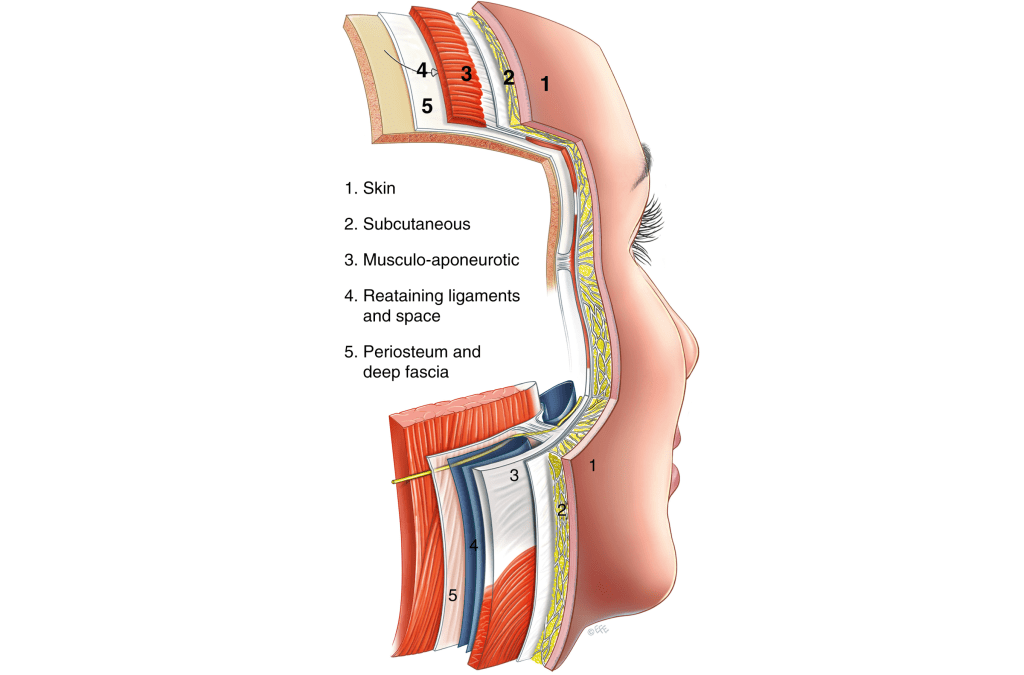
Jowls develop because several layers change at once. Not one failure, many. Skin loses elasticity. The fat compartments shift and descend. The SMAS layer loosens and drops. The retaining ligaments that once held everything in position weaken. And the facial skeleton itself changes shape, removing some of the scaffolding the soft tissue used to rest on.
On top of those structural changes sit the accelerants: genetics, sun exposure, smoking or vaping, and significant weight fluctuation, all of which can bring the timeline forward.
No single one of these causes a jowl. They compound, which is why a treatment aimed at only one layer tends to disappoint.
The Five Layers Behind a Jowl
Skin. The outermost layer loses collagen and elastin with age, sun exposure and smoking. Skin laxity is the most visible change and the most misleading, because tightening skin alone leaves every deeper cause untouched, and a result built on skin tension tends not to hold.
Fat compartments. Facial fat sits in discrete compartments rather than one even layer, more a stack of separate cushions than a single pad. With age these deflate and descend, so volume that once sat high in the cheek migrates downward and gathers at the jowl. Where volume loss is significant, facial fat transfer is sometimes part of a plan.
SMAS layer. The Superficial Musculoaponeurotic System is the supportive sheet beneath skin and fat, continuous with the platysma muscle of the neck. As it loosens and descends it draws the overlying skin and fat down with it. This is the layer most facelift surgery is really about: working on it is the basis of the SMAS facelift, and working beneath it is the basis of the deep plane facelift.
Retaining ligaments. These tether facial soft tissue to deeper structures, like tent pegs holding canvas taut. As they weaken, the tissue they held is free to slide downward. Releasing and repositioning around these ligaments is central to deeper facelift techniques.
Bone support. The facial skeleton provides the scaffolding everything rests on, and it remodels with age, the jaw and midface losing projection. Less underlying support means the soft tissue above has less to drape over. It’s the layer nobody thinks of, and it’s why two people with identical skin can age completely differently.
Jowls, Double Chin and Neck Bands Are Different Problems
These three get confused constantly and point to different procedures.
| Concern | Where it sits | What it is | What it is not |
|---|---|---|---|
| Jowls | Along the lower face and jawline | Descent of cheek and lower-face tissue | Not a fat problem, and not a neck problem |
| Double chin | Under the chin | Submental fat, sometimes with deeper neck structures | Not jawline descent |
| Neck bands | Front of the neck | Separation of the platysma muscle edges | Not skin laxity alone, and not jowling |
Plenty of patients have all three at once, which is exactly why assessment beats self-diagnosis. Treating one while assuming it will improve the others is the most common mismatch in this area.
How Jowls Develop Over Time
Jowls don’t appear overnight and don’t follow a schedule. The general pattern runs from early softening of the lower face, through more established tissue descent where the jowl is clearly defined, to broader lower-face and neck involvement where the change extends below the jaw.
The timeline varies enormously between people. Someone with strong bone support and thick skin may see little change for years; someone without that foundation may notice it far earlier. Anatomy writes the schedule, not the calendar.
Can You Prevent Jowls?
Not fully. Anatomy, genetics and ageing all play a role, and none is optional.
What you can influence is the timeline. Sun protection, avoiding smoking and vaping, maintaining a stable weight and looking after skin quality may all slow the rate at which the contributing changes accumulate. That is worth doing on its own merits, but it isn’t the same as prevention. Any product promising to stop jowls forming is overselling, usually by a wide margin.
Non-Surgical Options and Where They Stop
Non-surgical treatments have a real but bounded role. Skincare and energy-based treatments may help skin quality and some early changes. Filler may be discussed in selected patients to address volume rather than descent. Muscle-relaxing injectables have a narrow role where relevant. Thread lifts come up often in patient questions and carry meaningful limitations on both what they achieve and how long it lasts.
The honest summary: non-surgical treatments may help early changes or skin quality, but they don’t reposition descended lower-face tissue the way surgery does. When the problem is structural descent, a surface treatment has a ceiling, and patients often arrive having already found it.
Surgical Options for Jowls
When jowling is established and the cause is structural descent, surgery is the part of the conversation that addresses the underlying anatomy. Which operation depends on what’s involved.
Lower facelift is where isolated jowl concerns most often lead. It may be considered when the main concern is concentrated around the lower face, jawline and jowls, with the neck and midface relatively uninvolved.
Deep plane facelift may be discussed when jowls accompany deeper tissue descent, midface involvement or more extensive lower-face change, since it works beneath the SMAS layer.
Vertical Restore Facelift may be discussed when jowls form one part of a broader plan involving the brow, eyelids, neck or facial volume.
Neck lift or deep neck lift may form part of the plan where the neck is significantly involved.
The Limits of Each Approach
Every one of these operations has a boundary, and knowing where it sits prevents the most common disappointments.
What a lower facelift does not address. It does not correct the neck below the jawline, so platysmal banding, submental fullness and loose neck skin remain unless a neck component is included. It does not lift the midface, so flattening through the cheek and deepening tear troughs are untouched. It does not address the brow, forehead or eyelids. And it does not change skin quality: texture, pigmentation, fine lines and sun damage need skin-directed treatment regardless of how well the deeper layers are repositioned.
What a full or deep plane facelift does not address. The same skin-quality limitation applies. Deep neck structures, meaning subplatysmal fat, digastric muscle bulk and submandibular gland prominence, sit beneath the plane a facelift works in and need dedicated deep neck surgery where they are driving the contour. The upper face is generally a separate decision. And no facelift modifies the facial skeleton, so where reduced chin projection or jaw shape is contributing, soft-tissue surgery works around it rather than correcting it.
What a neck lift does not address. A neck lift treats the neck. It does not correct jowls or lower-face descent, so a patient with both who has neck surgery alone will often find the jawline still reads as heavy. This is the mismatch that most often prompts a second consultation.
The practical implication: the three concerns at the top of this article map to different operations, and the plan needs to cover whichever ones are present rather than the one that bothers you most.
There Is No Single Best Facelift for Jowls
Patients frequently search for the best facelift for jowls, and the honest answer is that no single technique holds that title.
A patient with early jowling, good skin quality and an uninvolved neck needs a different operation from one with heavy jowling, midface descent and platysmal banding. The first may be over-treated by a comprehensive procedure; the second will be under-treated by a limited one. Both mistakes are avoidable with assessment, and neither is avoidable by picking the technique with the best reputation.
A lower facelift may be discussed when jowls are clearly established, lower-face tissue descent is the main concern, and non-surgical treatment is unlikely to address the underlying anatomy. Suitability depends on the lower face, jawline, degree of neck involvement, skin quality, medical history and goals. Part of the assessment is identifying who is better served by something more limited, something broader, or by waiting a few years.
The Consultation Pathway
Cosmetic surgery in Australia requires a referral, preferably from your usual GP or another independent practitioner; a minimum of two pre-operative consultations, with at least one in person with the operating surgeon; a cooling-off period of at least seven days after informed consent; and psychological screening for suitability.
All facelift surgery carries risks including bleeding, infection, haematoma, asymmetry, scar issues, altered sensation, temporary or rarely permanent nerve weakness, and the possibility of revision. Results vary between individuals.
Frequently Asked Questions
What are jowls? Jowls are soft tissue changes along the lower face and jawline, usually beginning below the corner of the mouth and extending toward the jaw angle. They reflect lower-face tissue descent across several anatomical layers rather than loose skin alone, which is why they differ from a double chin under the chin or bands running down the front of the neck.
What causes jowls? Several layers change together: skin loses elasticity, facial fat compartments descend, the SMAS layer loosens, retaining ligaments weaken and the facial skeleton changes shape. Genetics, sun exposure, smoking or vaping and significant weight fluctuation can accelerate the process. Because multiple layers contribute, treatments aimed at only one tend to have limited effect.
Can jowls be treated without surgery? Skincare, energy-based treatments and selected injectables may help skin quality or early changes, but they don’t reposition descended lower-face tissue the way surgery does. Where the underlying problem is structural descent rather than surface skin quality, non-surgical options reach a ceiling relatively quickly.
What is the best facelift for jowls? There isn’t one. The appropriate operation depends on the pattern of change: a lower facelift where jowling is the isolated concern, a deep plane facelift where deeper descent or midface involvement is present, a broader plan where several areas are involved, and a neck component where the neck is affected. A technique chosen on reputation rather than assessment risks either over-treating or under-treating the anatomy present.
Will a neck lift fix my jowls? No. A neck lift addresses the neck, not the lower face, so jowls and jawline descent are unaffected by neck surgery alone. Patients with both concerns generally need the lower face addressed as well, whether through a lower facelift, a deep plane facelift or a combined procedure. Mistaking one for the other is among the most common reasons a result falls short of expectations.
If your jawline has softened and you’re weighing your options, the useful next step is an assessment of which layers and which zones are involved. Dr Scott Turner consults in Sydney and Brisbane. For clinic information and the consultation pathway, visit the Sydney clinic or Brisbane clinic, or contact the practice to arrange a consultation.

