




Tip rhinoplasty at a glance
| Procedure | Tip rhinoplasty (reshaping and support of the nasal tip and lower third of the nose) |
| Also known as | Nasal tip surgery, tip plasty, mini nose job (informal term) |
| Main focus | Lower lateral (tip) cartilages: shape, support, projection, rotation and definition |
| Common concerns treated | Bulbous, boxy, wide, drooping, over-projected, under-projected or asymmetrical tip |
| Usually does not change | Dorsal hump, bridge height, nasal bones, overall nasal width, whole-profile shape (tip projection can subtly alter the lip relationship) |
| Techniques | Suture reshaping, conservative cartilage reduction, cartilage grafting; open or closed approach |
| Anaesthesia | General anaesthesia |
| Surgery time | Approximately 1 to 2 hours |
| Hospital stay | Day surgery, same-day discharge is typical |
| Time off work | 7 to 10 days for most patients |
| Final result | Tip refinement continues for 12 to 18 months as swelling settles |
| Consultation fee | $450 |
| Total fee range | Approximately $13,500 to $18,000 |
| Medicare | Not eligible for cosmetic-only tip rhinoplasty |
| Sydney clinics | Bondi Junction and Manly |
What is tip rhinoplasty?
Tip rhinoplasty is a form of cosmetic rhinoplasty limited to the lower third of the nose. The structure of the nasal tip is formed by two curved pieces of cartilage, the lower lateral cartilages, sitting under the skin. Their size, strength, symmetry and the way they meet at the front of the nose determine whether a tip looks narrow and supported or round, broad or heavy. Tip rhinoplasty works on these cartilages directly: narrowing them, repositioning them, supporting them, or, where they are oversized, reducing them conservatively.
What tip rhinoplasty does not do is change the bridge. The dorsal hump, the height of the nasal bones and the overall profile of the nose are left as they are. This is the single most important thing to understand before considering the procedure. If your concern includes the bridge or the profile, a tip-only operation cannot address it, and full cosmetic rhinoplasty is usually the more appropriate procedure. If your concern is limited to the tip, then a tip-only approach avoids surgery on parts of the nose that do not need it.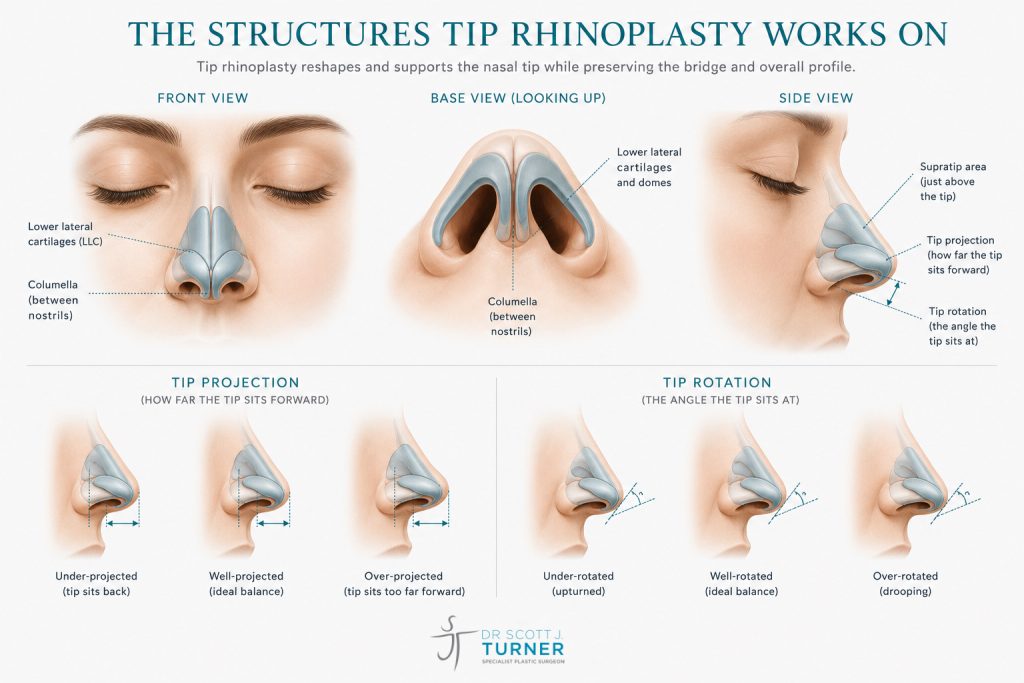
Other names for tip rhinoplasty
You will see this procedure described in several ways. Nasal tip surgery and tip plasty are clinical synonyms, the same operation on the same part of the nose. Nasal tip reduction, nasal tip reshaping and tip refinement surgery describe particular goals within tip rhinoplasty rather than different operations: reducing an oversized or over-projected tip, changing its shape, or improving its definition. And “mini nose job” is an informal term patients often use online. Whatever the label, this is surgery under general anaesthesia, not a minor procedure and not a non-surgical treatment.
What can realistically be achieved depends on your own anatomy, and skin thickness in particular. This is assessed at consultation, and the plan is built around what suits your nose rather than around a generic tip shape.
What tip rhinoplasty can correct
Tip rhinoplasty in Sydney is commonly performed for a specific set of tip concerns, and importantly, similar-looking tips can have quite different underlying causes. That is why two people who describe the same problem may need different surgical approaches. The concerns below are the ones tip rhinoplasty is most often used to address.
Bulbous tip
A bulbous, round or ball-shaped tip is the most common reason patients consider tip rhinoplasty. It is usually caused by lower lateral cartilages that are wide or convex, by thick overlying skin, by fibrofatty tissue in the tip, or by a combination of these. Surgery narrows the cartilages, most often with suture techniques that reposition the domes into a neater configuration, and sometimes with conservative cartilage reduction where the cartilage is clearly oversized. Because a rounded tip is such a frequent concern, some patients search specifically for bulbous tip rhinoplasty in Sydney; the operation is the same tip rhinoplasty, applied to a rounded tip. Skin thickness has a large influence on how visible the change will be, which is covered in detail below. For the anatomy behind a rounded tip, our bulbous nose tip guide goes further.
Boxy tip
A boxy tip looks square or angular from the front rather than round, usually because the two tip cartilages meet at a wide angle with a flat span between them. Suture techniques that bring the domes closer together and refine the angle between them are the usual approach. The aim is a tip that sits in proportion with the rest of the nose, not an artificially pinched one; over-narrowing a tip tends to look operated and can weaken support over time.
Wide tip
A wide tip is one that reads as broad across the front of the nose. It can overlap with a bulbous or boxy tip, or it can relate to the width of the nostril base beneath it. Where the width is in the tip cartilages themselves, nasal tip reshaping addresses it directly. Where the nostril base is also wide, alarplasty may be considered alongside tip surgery rather than instead of it, since the two procedures treat different structures and are often planned together.
Drooping tip
A drooping or ptotic tip sits lower than the patient would like and often becomes more noticeable when smiling, when the tip is pulled down further. Correction can involve rotating the tip upward, supporting it with cartilage grafts so it holds its position, and in some cases releasing the small muscle that pulls the tip down on smiling. How much rotation is possible depends on the existing cartilage and the surrounding anatomy, and a strongly turned-up tip is not the goal and would not suit most faces. The aim is a tip that sits in balance with the lip and the rest of the nose.
Over-projected tip
Projection describes how far the tip stands out from the face. An over-projected tip points too far forward and can make the nose look longer or more prominent than the patient wants. Reducing projection means conservatively adjusting the cartilage support that holds the tip forward, and doing so in a controlled way that keeps the tip stable. This is one of the situations where the term nasal tip reduction is used, reducing how far the tip projects rather than reducing its size overall.
Under-projected tip
An under-projected tip sits too flat or lacks support, which can make it look broad and poorly defined even when the cartilage itself is not especially large. Here the approach is the opposite of reduction: structural cartilage grafts are used to add support and bring the tip forward into a better-supported position. Adding projection in this way often does more for tip definition than removing tissue would.
Asymmetrical tip
An asymmetrical tip, where one side sits differently from the other, can be the result of natural variation, previous injury, or scarring from earlier nasal surgery. Correction begins with identifying why the tip is uneven, then addressing it through repositioning, grafting or reshaping the cartilages. Complete symmetry cannot always be promised, particularly where the asymmetry comes from the underlying septum or bones rather than the tip cartilages alone; in those cases a broader procedure may be needed. Honest discussion of what is achievable is part of the consultation.
What tip rhinoplasty cannot correct
Just as important as what tip rhinoplasty treats is what it leaves untouched. A tip-only operation does not address:
- A dorsal hump
- A crooked bridge
- The nasal bones
- Breathing or nasal obstruction
- A deviated septum
- Overall profile imbalance
If any of these is part of your concern, tip surgery alone will not resolve it, and full cosmetic rhinoplasty, functional surgery or septoplasty is the more appropriate route. This is one of the most useful things to establish early, because it is common to assume the tip is the issue when the bridge or profile is really driving the concern.
The role of skin thickness
Skin thickness is one of the most important factors in tip rhinoplasty, and it is the one patients researching online most often underestimate. The skin over the tip acts like a covering over the cartilage framework beneath it, and how thick that covering is decides how much of the surgical reshaping shows on the surface.
| Skin type | What it means for planning | What to expect from the result |
|---|---|---|
| Thin skin | Cartilage shape shows clearly through the skin | Refinement can appear earlier, often within 6 to 9 months. The trade-off is that small edges or minor asymmetries may also be more visible, so cartilage work is kept conservative. |
| Medium skin | Balanced visibility of the underlying structure | Swelling and definition follow a typical timeline; the result is usually settled around 12 months. |
| Thick skin | Cartilage detail is largely hidden by the skin | The visible change is more gradual and more subtle. Final tip definition can take 12 to 18 months as swelling slowly settles through the thicker tissue. |
Patients with thick skin often hope for a sharply defined tip. It is important to be clear at the outset that thick skin sets a limit on how much definition will show, regardless of how precise the cartilage work is; this is a feature of the tissue, not of the technique. Patients with thin skin face the opposite issue: because the skin conceals so little, surgery has to be planned conservatively so that edges and contours do not show through. Skin thickness is assessed at your consultation and built into both the surgical plan and the conversation about realistic expectations. Our thick-skin rhinoplasty guide covers this in more depth.

Cartilage grafts and surgical techniques
Modern tip rhinoplasty focuses on preserving strength rather than removing cartilage. Older techniques that relied on cutting cartilage away often looked acceptable at first but weakened the tip over the following years, leading to collapse, breathing problems and the need for revision. The techniques below are used in combination, chosen to suit the individual tip.
Surgical approach: open or closed
Tip rhinoplasty can be performed through a closed approach, with all incisions hidden inside the nostrils and no external scar, or an open approach, which adds a small incision across the columella (the strip of skin between the nostrils). The open approach gives direct access to both tip cartilages at once and is preferred for asymmetrical tips, grafting and more detailed work; the columellar scar typically settles to a fine line over 6 to 12 months. The closed approach suits more limited reshaping. Which is used depends on what the tip needs, and is discussed with you beforehand.
Suture techniques
Sutures are used to reshape the tip cartilages without removing them: narrowing a wide or bulbous tip, bringing an asymmetrical pair of cartilages into balance, and setting tip definition. Because the cartilage is preserved rather than cut away, suture-based reshaping supports long-term stability and reduces the risk of the tip weakening over time.
Conservative cartilage reduction
Where the tip cartilages are clearly oversized, a small, measured amount may be trimmed alongside suture work, the basis of nasal tip reduction. The guiding principle is to preserve as much cartilage as possible. Over-reduction is avoided precisely because it is the cause of the delayed collapse seen in some noses operated on decades ago.
Cartilage grafts
Grafts are pieces of your own cartilage used to support, reposition or reshape the tip. Common grafts in tip rhinoplasty include columellar strut grafts that support the tip from below, tip grafts that improve definition or projection, and septal extension grafts that set the tip in a chosen position. The cartilage is usually taken from the septum inside the nose during the same operation; where more is needed, ear cartilage can be used, and rib cartilage is reserved for revision or complex reconstruction. Grafting is central to tip refinement surgery because adding controlled support often achieves more than removing tissue.
What determines the final tip shape?
The tip you end up with is shaped by more than the operation itself. Five factors matter most:
- Cartilage. The size, strength and symmetry of your tip cartilages set what can be reshaped and how well it holds.
- Skin thickness. Thin skin reveals the underlying shape; thick skin conceals it and slows definition.
- Healing. Everyone heals differently, and individual healing influences both swelling and the final contour.
- Support grafts. Grafts that reinforce the tip help the result hold its position over time rather than settling or dropping.
- Scar tissue. Internal scar tissue forms as part of healing and can affect how much of the fine detail shows, particularly in thicker skin.
None of these work in isolation. The plan is built around all five together, which is why two people having the same technique can end up with different results.
Tip rhinoplasty vs full rhinoplasty
The clearest way to choose between the two is to ask what needs to change.
| Tip rhinoplasty | Full cosmetic rhinoplasty | |
|---|---|---|
| Main focus | Lower third: tip cartilages, projection, rotation, support | Bridge, dorsum, nasal bones, tip and whole profile |
| Dorsal hump | Not addressed | Can be addressed |
| Nasal bones | Not changed | May involve osteotomies |
| Overall width | Not addressed | Can be addressed |
| Surgery time | 1 to 2 hours | 2 to 4 hours |
| Best suited to | Isolated tip concerns, with the rest of the nose left alone | Bridge, profile or whole-nose concerns |
A quick way to orient yourself:
Is your concern only the tip?
- Yes: tip rhinoplasty may be suitable.
- No: full cosmetic rhinoplasty usually gives a better overall result.
A common misunderstanding is that a tip-only procedure recovers far faster in every respect. In the parts that matter to the patient, it does not: tip swelling is the slowest part of any rhinoplasty to settle, so even tip-only surgery carries a 12 to 18 month timeline for the final shape, and the first two weeks (splint, swelling, activity restrictions) feel similar to a full rhinoplasty.
It is also worth knowing that many patients arrive certain they want tip-only surgery when their concern in fact includes the bridge, and some arrive expecting a full rhinoplasty when the tip alone is the issue. Which procedure is right is decided at assessment. Where both the bridge and tip clearly need work, a single planned full rhinoplasty almost always gives a more balanced result than treating the tip now and the bridge later. Our mini nose job decision guide walks through how to tell which situation applies to you.
Tip rhinoplasty vs alarplasty
Tip rhinoplasty and alarplasty both involve the lower nose but treat different structures, and they are often confused.
| Your concern | The procedure that applies |
|---|---|
| Bulbous, boxy or poorly supported tip | Tip rhinoplasty |
| Drooping tip, or projection / rotation | Tip rhinoplasty |
| Wide nostril base | Alarplasty |
| Both tip shape and nostril width | Combined tip rhinoplasty and alarplasty |
In short: tip rhinoplasty changes the shape of the tip itself; alarplasty narrows the nostril base where it meets the lip. A patient with wide nostrils but a well-supported tip needs alarplasty, not tip surgery; a patient with a bulbous tip and narrow nostrils needs tip surgery, not alarplasty. Where both apply, the two can be done together in one operation.
Combining tip rhinoplasty with other procedures
Tip rhinoplasty is sometimes performed with another nasal procedure in the same operation, where the combination gives a better result than tip work alone.
| Combined with | When it applies |
|---|---|
| Alarplasty | Nostril width is a concern alongside the tip |
| Septoplasty | A deviated septum is causing breathing difficulty |
| Functional rhinoplasty | Nasal valve or other structural breathing issues are present |
| Full cosmetic rhinoplasty | The bridge or profile also needs treatment |
| Revision rhinoplasty | The tip needs correction after previous nasal surgery |
Combined procedures are only recommended where the assessment supports them, not as an add-on. Where the bridge also needs work, full rhinoplasty is usually the better single operation rather than tip surgery followed by a later bridge procedure. Combining does lengthen the operation and the total fee reflects the additional work, but early recovery is broadly similar to tip rhinoplasty alone.
Are you a suitable candidate?
Tip rhinoplasty suits patients whose main concern is the tip and who are content with the rest of the nose. Suitability is both physical and personal.
Physical suitability
- Good general health, with any ongoing conditions well managed
- Non-smoker, or willing to stop for a defined period before and after surgery
- Completed nasal growth (generally 17 years and older)
- Enough cartilage available for the planned reshaping or grafting
- Satisfied with the bridge, dorsum and overall profile
Realistic expectations
- Goals driven by your own preferences rather than outside pressure
- An understanding that thick skin limits how much definition will show
- An acceptance that final tip shape takes 12 to 18 months to settle
- Willingness to follow the required process, including the cooling-off period and, where it applies, an independent psychological assessment
When tip rhinoplasty is not the right procedure
A tip-only operation is not appropriate for a dorsal hump or bridge concern, crooked nasal bones, overall width, or significant breathing difficulty; these need full rhinoplasty, functional surgery or septoplasty. Where those factors are present, Dr Turner will explain the alternative that fits. In some cases the patient who books expecting tip surgery turns out to be better suited to a full rhinoplasty, and occasionally to no surgery at all, and the honest answer is part of the consultation.
The consultation and surgical process
Every tip rhinoplasty patient follows a structured pathway, in line with Medical Board and AHPRA requirements for cosmetic surgery. The steps exist so that you have the time, information and assessment to make an informed decision before anything is scheduled.
| Step | What happens |
|---|---|
| 1. GP referral | Required before your first consultation |
| 2. First consultation | Assessment of the external and internal nose, skin thickness, cartilage support and your goals; the process and options explained |
| 3. Photography & 3D imaging | Standardised photographs; 3D imaging may be used as a planning and discussion tool, not a guarantee of outcome |
| 4. Cooling-off period | A minimum of 7 days for adults; a minimum of 3 months for patients under 18 |
| 5. Psychological assessment | An independent assessment where AHPRA criteria apply |
| 6. Second consultation | The surgical plan is reviewed, alternatives and risks confirmed, and written informed consent obtained |
| 7. Surgery | Performed under general anaesthesia at an accredited Sydney private hospital; same-day discharge is typical |
| 8. Follow-up | Splint removal at 7 to 10 days, then reviews at 6 weeks, 3 months, 6 months and 12 months |
Two consultations with Dr Turner are required before any cosmetic surgery is booked.
Tip rhinoplasty recovery
Early recovery follows a similar path to full rhinoplasty, though the operation is shorter and the result more localised. The most important point to hold onto is that tip swelling is the slowest part of any nose surgery to settle: the tip you see in the first months is not the final tip. The rhinoplasty recovery timeline tracks each stage in detail.
| Timeframe | What to expect |
|---|---|
| Week 1 | Splint in place; swelling and bruising around the eyes and cheeks. Most patients take 7 to 10 days off work. |
| End of week 1 | Splint removed. Swelling continues but is less obvious. |
| Weeks 2 to 3 | Bruising fades; many patients return to office-based work. |
| Weeks 4 to 6 | Swelling settles further. Light exercise usually resumes from week 4 on Dr Turner’s advice; contact sport and anything that risks a knock to the nose is avoided. |
| Months 3 to 6 | Tip shape starts to show, most noticeably in thin and medium skin. |
| 6 to 12 months | Most swelling has resolved and the tip shape becomes clear. |
| 12 to 18 months | Final tip refinement, particularly in thicker skin where the timeline runs longer. |
Follow-up appointments track the tip through this period. Thick skin, revision surgery and cartilage grafting generally extend the timeline. Our week-by-week rhinoplasty recovery guide sets out the full timeline.
Cost of tip rhinoplasty in Sydney
Typical fee: $13,500 to $18,000.
Total fees for tip rhinoplasty at Dr Turner’s Sydney practice typically range from approximately $13,500 to $18,000. The lower end reflects more contained tip cases; the upper end reflects more complex work such as extensive grafting, revision tips, or a combined procedure like alarplasty in the same operation.
The total fee generally includes:
- The surgical fee
- The anaesthetist’s fee
- Hospital admission (usually day surgery)
- Standard post-operative follow-up at 6 weeks, 3 months, 6 months and 12 months
The initial consultation fee is $450, which includes the second consultation required before surgery. Tip rhinoplasty performed for cosmetic reasons does not attract a Medicare rebate. Where tip work is combined with a functional procedure, for example a septoplasty for a breathing problem in the same operation, the functional portion may be eligible for a Medicare item number, but the cosmetic tip work is not. Private health fund contributions follow the same principle and are limited to any functional component. The exact fee depends on cartilage grafting, surgical complexity, whether revision surgery is required, and whether additional procedures such as alarplasty are performed. Where your fee sits within the range depends on your individual plan, which is set at consultation. Our rhinoplasty cost guide breaks the fees down further.
Risks and complications
All surgery carries risk, and tip rhinoplasty is no exception. The recognised risks include:
- Bleeding: significant post-operative bleeding is uncommon but possible
- Infection: antibiotics are used, but infection remains a recognised risk
- Asymmetry: some asymmetry is normal during healing; persistent asymmetry may need revision
- Persistent swelling: particularly in the tip, and longer in thicker skin
- Scarring: a small columellar scar with the open approach, which usually settles to a fine line but is not invisible
- Visible or palpable cartilage: more likely in thin skin, where edges can show or be felt
- Changes in sensation: temporary tip numbness is common; lasting change is uncommon
- Altered breathing: tip changes can occasionally affect airflow, which is assessed beforehand
- Loss of tip support over time: a risk where too much cartilage is removed, which is why support is preserved
- Dissatisfaction with the result: tip rhinoplasty does not guarantee a particular outcome, and thick skin may limit the definition achieved
- The need for revision surgery
- Risks of general anaesthesia: including reactions to medication and, rarely, more serious complications
Persistent tip swelling is particularly common in thicker skin and does not necessarily indicate a poor outcome. Your individual risk depends on your anatomy, health, skin thickness, smoking status, healing and the complexity of the plan. Dr Turner discusses the risks relevant to your case in detail at consultation. For more, see our risks and complications resource.
Related nose surgery pages and guides
If you are not yet sure tip rhinoplasty is the right procedure, these pages and articles may help:
- Cosmetic Rhinoplasty, if the bridge or whole profile is part of your concern
- Alarplasty, if nostril width is the main issue
- Revision Rhinoplasty, if you are unhappy with the tip after previous surgery
- Functional Rhinoplasty, if breathing is affected alongside tip concerns
- Mini nose job or tip rhinoplasty?, a decision guide on whether surgery can be limited to the tip
- Bulbous nose tip, why a tip looks round, and what can be done
- Thick skin and rhinoplasty, how skin thickness shapes the result
- Rhinoplasty cost guide, a full breakdown of Sydney rhinoplasty fees
Frequently Asked Questions
Is tip rhinoplasty the same as a nasal tip surgery or tip plasty?
Yes. Nasal tip surgery and tip plasty are other names for the same operation, surgery focused on the lower third of the nose. Nasal tip reduction, nasal tip reshaping and tip refinement surgery describe particular goals within it. “Mini nose job” is an informal term for the same procedure. All of them mean surgery under general anaesthesia, not a minor treatment.
Will tip rhinoplasty change my bridge?
No. Tip rhinoplasty treats only the lower third of the nose. The bridge, dorsal hump, nasal bones and overall profile are left unchanged. If the bridge is part of your concern, full cosmetic rhinoplasty is the procedure that applies.
Can tip rhinoplasty correct a bulbous tip?
It can address many bulbous tips, mainly through suture techniques that narrow the tip cartilages and, where needed, conservative cartilage reduction. How much of the change shows on the surface depends on skin thickness. Thin and medium skin show it more clearly, while thick skin can conceal even well-executed work. Patients with thick skin should hold realistic expectations about visible definition.
Can tip rhinoplasty lift a drooping tip?
In selected patients, yes, through rotation, cartilage support grafts, and where relevant releasing the muscle that pulls the tip down on smiling. How much lift is possible depends on your cartilage and surrounding anatomy. A specific angle cannot be promised; the goal is balance with the rest of the nose.
Can tip rhinoplasty make the nose narrower?
It can narrow the tip itself. Narrowing the nostril base is a separate procedure, alarplasty, which can be combined with tip rhinoplasty when both the tip and the nostril width are a concern.
How much does tip rhinoplasty cost in Sydney?
Total fees typically range from approximately $13,500 to $18,000, depending on complexity, grafting and whether procedures are combined. The consultation fee is $450. Cosmetic-only tip rhinoplasty is not Medicare-eligible.
How long is recovery?
Most patients take 7 to 10 days off work, with the splint removed at the end of the first week. Bruising fades by around week three and the most visible swelling settles over the first month. Final tip definition develops over 12 to 18 months, at the longer end for thicker skin.
Is a "mini nose job" less risky than a full nose job?
The scope is smaller, but the risk categories are the same. Bleeding, infection, asymmetry, altered breathing, dissatisfaction and the possible need for revision all apply, and it is still performed under general anaesthesia. It should not be thought of as a minor cosmetic adjustment.
Can tip rhinoplasty be performed without changing the rest of the nose?
Yes, that is the point of it. Tip rhinoplasty is limited to the lower third of the nose, so the bridge, dorsal hump, nasal bones and overall profile are left as they are. It suits patients who are happy with the rest of the nose and want only the tip addressed. If the bridge or profile also needs work, a full cosmetic rhinoplasty gives a more balanced result than treating the tip in isolation.
Book a consultation with Dr Turner
If your main concern is the nasal tip and you are happy with the rest of your nose, the next step is a consultation to assess your cartilage, skin thickness, tip support, projection and rotation, and to confirm whether tip rhinoplasty, or another nasal procedure, is the right approach for you. During consultation I assess whether your concern is isolated to the tip, or whether the bridge, profile or breathing would be better addressed with a broader rhinoplasty procedure. Dr Scott Turner is a Specialist Plastic Surgeon (FRACS) who consults on tip rhinoplasty and nasal tip surgery at his Bondi Junction and Manly clinics in Sydney.
Contact us to arrange your consultation. Phone: 1300 437 758 Bondi Junction: 39 Grosvenor Street, Bondi Junction NSW Manly: Suite 504, Level 5, 39 East Esplanade, Manly NSW
Two consultations are required before any cosmetic surgery is scheduled, in line with Medical Board and AHPRA requirements. All surgery carries risks. Results vary from patient to patient depending on individual anatomy, skin thickness and healing. This page is general information and not a substitute for a consultation with a qualified surgeon.
Schedule a clinical evaluation with Dr Turner
If your main concern is the nasal tip and you are satisfied with the rest of your nose, a consultation is required to assess the cartilage structure, skin thickness, tip support, projection, rotation, and whether tip rhinoplasty or another nasal surgery pathway is the right approach for your case. Dr Scott Turner is a Specialist Plastic Surgeon (FRACS) who consults with patients about tip rhinoplasty and related nasal procedures at his Bondi Junction and Manly clinics.
To schedule a clinical evaluation, contact our team.
Phone: 1300 437 758 Email: [email protected] Bondi Junction: 39 Grosvenor Street, Bondi Junction NSW Manly: Suite 504, Level 5, 39 East Esplanade, Manly NSW
Two consultations are required before any cosmetic surgery is scheduled, in line with Medical Board and AHPRA requirements.

