



Cosmetic rhinoplasty at a glance
| Item | Summary |
|---|---|
| Procedure | Cosmetic rhinoplasty (reshaping the nose for appearance) |
| Common concerns | Dorsal hump, nasal tip, nasal width, bridge shape, asymmetry, post-traumatic change |
| Techniques | Open rhinoplasty or closed rhinoplasty |
| Anaesthesia | General anaesthesia |
| Typical surgery duration | 2 to 4 hours |
| Hospital stay | Day surgery or one overnight stay, depending on case |
| Initial recovery | 7 to 10 days off work; splint removed at approximately one week |
| Final result | Typically apparent at 12 to 18 months |
| Medicare eligibility | Not eligible for cosmetic-only procedures |
| Consultation fee | $450 |
| Total fee range | Approximately $18,000 to $28,000 |
| Sydney clinics | Bondi Junction and Manly |
What cosmetic rhinoplasty may address
Cosmetic rhinoplasty addresses a wide range of concerns, but the same external appearance can have different underlying causes. Each concern is assessed individually at consultation to determine the most appropriate surgical approach.
Dorsal hump or nasal bridge shape
A dorsal hump is a prominence on the bridge of the nose, visible on the profile view. It can be caused by bone, cartilage, or a combination of both. Reduction may involve filing, rasping, or controlled resection of the underlying structure. Where a hump reduction would leave the bridge too narrow at the top, lateral osteotomies (controlled bone cuts) are performed to close the open roof and restore a smooth dorsum. Some patients have an under-projected radix (the area between the eyebrows), which can give the appearance of a larger hump than is actually present; in these cases, radix augmentation rather than reduction may be the appropriate approach.
Nasal tip shape and support
Tip concerns include a bulbous tip, a drooping or over-rotated tip, an under-projected tip, an asymmetric tip, and a poorly defined tip. The tip is supported by paired lower lateral cartilages, and tip surgery involves reshaping, repositioning, or augmenting these structures with cartilage grafts where additional support is required. Tip refinement is typically the longest part of recovery, with final definition continuing to develop over 12 to 18 months. For patients whose only concern is the nasal tip, see our tip rhinoplasty page.
Nose size, width and facial balance
Some patients are concerned about the overall size of the nose, the width of the bridge, or how the nose sits in proportion to the rest of the face. Reduction rhinoplasty addresses these concerns through dorsal reduction, osteotomies to narrow the bony bridge, and tip adjustments. Facial balance is assessed holistically: the goal is not a specific nasal shape but a result that suits the rest of the face, including the chin, forehead, and overall facial proportions.
Nostril shape and alar base width
Wide nostrils or a wide alar base (where the base of the nose meets the upper lip) can be addressed through alarplasty, a procedure that narrows the alar base. Alarplasty may be performed alongside cosmetic rhinoplasty when nostril width is part of the overall concern, or as a standalone procedure where only the alar base requires adjustment. The technique involves small incisions placed in the natural creases at the base of the nostrils.
Post-traumatic nasal change
A previous nasal injury, even one that occurred years earlier, can leave the nose with a visible deviation, a depressed bridge, an asymmetric tip, or a combination of these. Where the injury also caused internal structural damage that affects breathing, cosmetic rhinoplasty alone may not be the appropriate procedure. In these cases, a combined approach (septorhinoplasty) addresses both the cosmetic and functional concerns at the same time. See our broken nose and functional rhinoplasty pages for more on injury-related nasal change.
Ethnic and individual anatomy
Patients from non-Caucasian backgrounds often have specific anatomical considerations that influence surgical planning, including thicker skin, weaker cartilage support, a lower radix, a wider alar base, and a less projected nasal tip. The surgical goal is not to change the patient’s ethnic identity but to refine the nose in a way that respects their natural anatomy and aesthetic preferences. See our ethnic rhinoplasty page for a detailed discussion.
Open versus closed cosmetic rhinoplasty
Cosmetic rhinoplasty can be performed using either an open or closed surgical approach. The choice of technique is made by Dr Turner based on the complexity of your case, your anatomy, the work that needs to be done, and any previous nasal surgery.
| Technique | Incisions | Best suited for | Considerations |
|---|---|---|---|
| Closed rhinoplasty | Inside the nostrils only | Limited bridge work, isolated tip refinements, selected dorsal hump reductions with good cartilage support | No external scar; more limited surgical visualisation |
| Open rhinoplasty | Inside the nostrils plus a small incision across the columella | Complex tip work, structural cartilage grafting, revision rhinoplasty, most ethnic rhinoplasty | Direct visualisation of the nasal framework; small columellar scar that typically fades to a fine line |
Closed cosmetic rhinoplasty uses incisions placed entirely inside the nostrils. There is no external scar. The closed approach suits straightforward refinements where the underlying structures do not need to be extensively repositioned. Surgical visualisation is more limited because the skin envelope of the nose is not lifted away from the underlying framework.
Open cosmetic rhinoplasty uses the same internal incisions plus a small additional incision across the columella, the strip of skin between the nostrils. This allows the skin envelope to be lifted, giving direct visualisation of the nasal cartilages and bones. The open approach is preferred for complex tip work, structural cartilage grafting, revision rhinoplasty, most ethnic rhinoplasty cases, and cases where significant changes to the underlying framework are planned. The columellar scar typically fades to a fine line over 6 to 12 months and is rarely visible in everyday interactions.
There is no universal “best” approach. Dr Turner discusses the technique selection in detail at consultation, and the recommended approach is explained in the context of your specific anatomy and goals.
Dr Turner’s approach to cosmetic rhinoplasty
Cosmetic rhinoplasty is one of the most technically demanding procedures in plastic surgery. Small changes can have a significant impact on facial balance, and the internal anatomy (cartilage, bone, mucosa, and the nasal airway) all interact in ways that require careful planning. Dr Turner’s approach to cosmetic rhinoplasty is built around three principles: whole-nose assessment, clear communication, and realistic expectations.
Whole-nose assessment
Before any surgical plan is made, Dr Turner assesses the nose as a whole structure. This includes the external shape (bridge, tip, alar base, nostrils), the internal anatomy (septum, nasal valves, turbinates), the skin thickness, the cartilage support, and the relationship of the nose to the rest of the face. A patient who arrives focused only on the bridge may also have tip support issues that, if not addressed, will compromise the long-term result. Conversely, patients who arrive focused on the tip may have a bridge that requires only minimal adjustment to achieve overall balance.
Digital imaging as a communication tool
Where appropriate, 3D imaging is used during consultation to illustrate the proposed surgical plan. This is a communication and planning tool, not a guarantee of result. The imaging helps patients understand what is realistically achievable for their anatomy and gives Dr Turner an opportunity to discuss what each proposed change involves surgically. The final result depends on healing, skin behaviour, and individual anatomy, none of which can be fully predicted by imaging. For more on how 3D imaging is used in consultation, see our 3D imaging in rhinoplasty guide.
Realistic expectations and operating decisions
Dr Turner does not perform cosmetic rhinoplasty on every patient who requests it. Where expectations do not align with what is anatomically achievable, or where the patient appears to be making the decision under pressure from others, the procedure is not recommended. This approach is consistent with the AHPRA cosmetic surgery framework and is part of the structured consultation process required before any cosmetic surgery is scheduled.
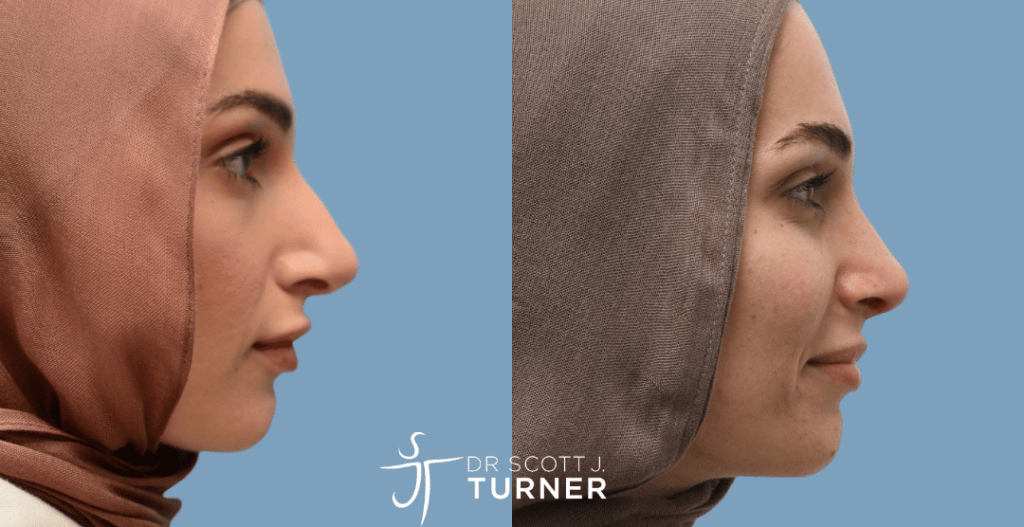
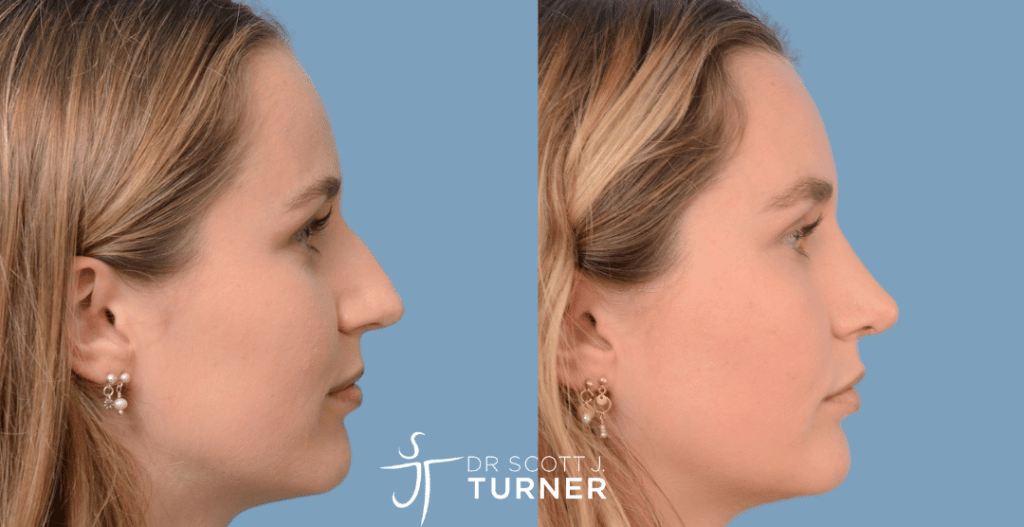
To see results from previous patients, visit the rhinoplasty before and after gallery.
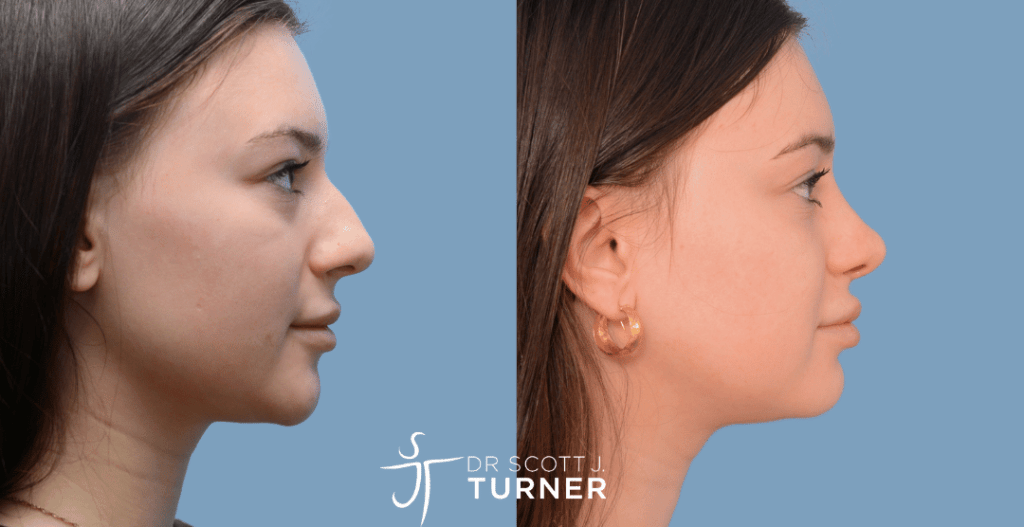
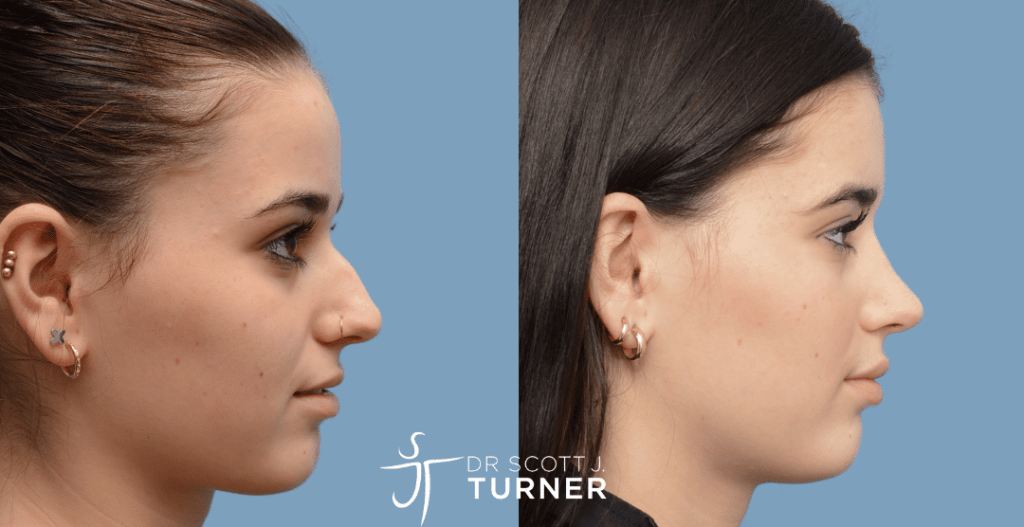
Cosmetic, functional, and combined nose surgery
Cosmetic rhinoplasty is one of several procedures that may be considered when a patient is unhappy with the appearance or function of the nose. Where breathing problems, a deviated septum, or other functional concerns are present alongside cosmetic concerns, a different surgical plan may be required.
| Pathway | Main concern | Best next page |
|---|---|---|
| Cosmetic rhinoplasty | Appearance, profile, tip, size, bridge, nostril shape | This page |
| Functional rhinoplasty | Breathing, nasal valve collapse, structural airway issues | Functional Rhinoplasty |
| Septoplasty | Deviated septum and internal obstruction | Septoplasty |
| Septorhinoplasty | Combined cosmetic and functional concerns | Functional Rhinoplasty |
| Revision rhinoplasty | Concerns after prior nose surgery | Revision Rhinoplasty |
For an overview of all nose surgery pathways and Medicare eligibility, see our nose surgery hub.
Are you a suitable candidate for cosmetic rhinoplasty?
Cosmetic rhinoplasty is not appropriate for every patient. Dr Turner assesses each patient against both physical and emotional criteria before determining whether to recommend the procedure.
Physical suitability
- Good general health, with any chronic conditions well controlled
- Non-smoker, or willing to stop smoking for a defined period before and after surgery (smoking significantly increases healing complications)
- Completed nasal growth (typically 17 years and older for females, slightly older for males)
- Adequate cartilage and bone structure to support the proposed changes
- No active nasal infection or untreated nasal pathology
Emotional and psychological suitability
- Motivation driven by the patient’s own goals rather than external pressure
- Realistic, anatomy-based expectations of what cosmetic rhinoplasty can achieve
- Understanding that final results take 12 to 18 months to fully develop
- Willingness to follow the AHPRA cosmetic surgery process, including the cooling-off period and (where applicable) independent psychological assessment
When cosmetic rhinoplasty may not be appropriate
There are several situations in which Dr Turner will not recommend cosmetic rhinoplasty:
- Unrealistic expectations that do not align with the patient’s underlying anatomy
- Body dysmorphic disorder or other psychological factors that suggest the surgery will not address the patient’s underlying concerns
- Active smoking with no plan to stop
- A history of previous rhinoplasty with insufficient cartilage available for further surgery
- Pressure from a partner, family member, or third party to undergo the procedure
- Inadequate understanding of the risks, recovery, or limitations of the procedure
Where any of these factors are identified at consultation, Dr Turner explains why the procedure is not recommended and discusses whether alternative pathways may be appropriate.
The cosmetic rhinoplasty consultation and surgical process
Every cosmetic rhinoplasty patient follows a structured process, in line with Medical Board and AHPRA requirements for cosmetic surgery.
| Step | What happens |
|---|---|
| 1. GP referral | Required before the initial consultation; reviewed at intake |
| 2. First consultation | Clinical assessment of external and internal nasal anatomy, medical history, goals, surgical options, risks, and the AHPRA cosmetic surgery process explained |
| 3. Photography and 3D imaging | Standardised photographs taken; 3D imaging used as a planning and communication tool, not a guarantee of outcome |
| 4. Cooling-off period | Minimum 7 days for adults; minimum 3 months for patients under 18, per AHPRA cosmetic surgery requirements |
| 5. Psychological assessment | Independent assessment required where AHPRA criteria apply, including all patients under 18 |
| 6. Second consultation | Surgical plan reviewed, alternatives discussed, risks confirmed, written informed consent obtained |
| 7. Surgery | Performed under general anaesthesia at an accredited Sydney private hospital |
| 8. Follow-up | Splint removal at 7 to 10 days; further appointments at 6 weeks, 3 months, 6 months, and 12 months |
The structured process exists to ensure that every patient has the time, information, and assessment they need to make an informed decision before any cosmetic surgery is performed. It is not a marketing process; it is a regulatory and clinical requirement.
Cost of cosmetic rhinoplasty in Sydney
Total fees for cosmetic rhinoplasty at our Sydney practice typically range from approximately $18,000 to $28,000. The exact fee depends on the complexity of the procedure, the surgical technique required (open versus closed, with or without structural grafting), anaesthetic fees, and hospital admission costs.
The total cost typically includes:
- Surgical fee (Dr Turner)
- Anaesthetist fee
- Hospital admission (day surgery or one overnight stay depending on case)
- Standard post-operative follow-up appointments at 6 weeks, 3 months, 6 months, and 12 months
The initial consultation fee is $450. The second consultation, required before any cosmetic surgery is scheduled, is included in this fee.
Cosmetic rhinoplasty does not attract Medicare benefits in Australia. Where a procedure combines cosmetic and functional elements (for example, where a deviated septum is corrected at the same time as a cosmetic dorsal reduction), the functional portion may be eligible for a Medicare rebate against item 45641 or 41671. For more on Medicare-eligible nose surgery, see our nose surgery hub.
Private health insurance contributions to cosmetic rhinoplasty are limited. Some funds contribute to hospital costs where a Medicare item number is involved (i.e., where there is a functional component); cosmetic-only procedures are not typically eligible for private health rebates.
For a detailed cost breakdown, see our rhinoplasty cost guide.
Cosmetic rhinoplasty recovery
Recovery from cosmetic rhinoplasty varies by individual healing response, skin thickness, and the complexity of the surgical changes. The timeline below is a general guide for primary (first-time) cosmetic rhinoplasty.
| Timeframe | What to expect |
|---|---|
| Week 1 | External splint in place. Swelling and bruising around the eyes and cheeks. Most patients take 7 to 10 days off work. |
| Weeks 2 to 3 | Splint removed at approximately one week. Visible bruising fades. Many patients return to office-based work. |
| Weeks 4 to 6 | Swelling continues to settle. Light exercise typically resumes from week 4 depending on Dr Turner’s advice. |
| Months 3 to 6 | Ongoing refinement, particularly around the nasal tip. Most patients feel comfortable in social settings. |
| 6 to 12 months | Most swelling has resolved. Subtle changes continue. |
| 12 to 18 months | Final cosmetic result typically apparent. Patients with thicker skin may continue to refine slightly beyond this point. |
Patients are seen for follow-up at splint removal (day 7 to 10), and then at 6 weeks, 3 months, 6 months, and 12 months. Dr Turner monitors swelling, healing, and gradual refinement at each appointment.
For a more detailed recovery breakdown, see our rhinoplasty recovery timeline guide.
Cosmetic rhinoplasty risks and complications
All surgery carries risk. The specific risks of cosmetic rhinoplasty include:
- Bleeding: Significant post-operative bleeding is uncommon but possible.
- Infection: Antibiotic prophylaxis is used, but infection remains a recognised risk.
- Asymmetry: Minor asymmetry is common during healing; persistent asymmetry may require revision.
- Persistent swelling: Particularly in the nasal tip, where swelling can persist beyond 12 months in patients with thicker skin.
- Scarring: A small columellar scar is present after open rhinoplasty; it typically fades to a fine line but is not invisible.
- Septal perforation: An uncommon but serious complication where a hole develops in the septum.
- Changes in nasal sensation: Temporary numbness of the nasal tip is common; permanent sensory change is uncommon.
- Breathing changes: Cosmetic changes can sometimes alter airflow; this is assessed pre-operatively and managed where possible.
- Cosmetic outcome dissatisfaction: Cosmetic rhinoplasty does not guarantee a particular result. Some patients are not satisfied with the outcome even when the surgery has gone technically well.
- Need for revision surgery: Some patients require a touch-up or full revision procedure. Revision rates vary by case complexity.
- General anaesthetic risks: These include reactions to medications, breathing difficulties, and (rarely) more serious complications.
The individual risk profile for your case depends on your anatomy, medical history, smoking status, healing capacity, and the complexity of the surgical plan. Dr Turner discusses the specific risks relevant to your case in detail at consultation.
Related nose surgery procedures
If you are not sure whether cosmetic rhinoplasty is the right procedure for your concerns, the pages below cover related procedures and pathways.
| Related page | When to read it |
|---|---|
| Nose Surgery Hub | If you are not yet sure which nasal procedure applies to your concerns |
| Tip Rhinoplasty | If your only concern is the nasal tip rather than the bridge or whole nose |
| Alarplasty | If nostril width or alar base shape is your main concern |
| Ethnic Rhinoplasty | If anatomical considerations specific to non-Caucasian backgrounds apply |
| Male Rhinoplasty | If male-specific structural and aesthetic considerations apply |
| Revision Rhinoplasty | If you are dissatisfied with a previous rhinoplasty result |
| Functional Rhinoplasty | If you have breathing difficulties alongside any cosmetic concerns |
| Septoplasty | If a deviated septum is contributing to breathing problems |
| Teen Rhinoplasty | If the patient is an adolescent |
| Broken Nose | If your concerns relate to a recent nasal injury |
Helpful cosmetic rhinoplasty guides
The articles below provide deeper information on specific aspects of cosmetic rhinoplasty.
- Rhinoplasty cost in Sydney: Full breakdown of consultation, surgical, anaesthetic, and hospital fees
- Common rhinoplasty questions: Questions Dr Turner hears most often at consultation
- Cosmetic vs functional rhinoplasty: How the two pathways differ
- Rhinoplasty recovery timeline: Week-by-week guide from surgery through to final result
- How to choose a rhinoplasty surgeon: What credentials, experience, and consultation signals to look for
- 3D imaging in rhinoplasty planning: How digital imaging is used during consultation
Frequently Asked Questions
What is cosmetic rhinoplasty?
Cosmetic rhinoplasty is surgery that reshapes the nose for aesthetic reasons. It may address the dorsal hump, nasal tip, nose size and width, nostril shape, asymmetry, or post-traumatic structural changes. It is distinct from functional rhinoplasty, which addresses breathing problems caused by internal structural issues. Cosmetic rhinoplasty in Australia does not attract Medicare benefits and follows the AHPRA cosmetic surgery framework.
What concerns can cosmetic rhinoplasty address?
The most common cosmetic concerns include a dorsal hump on the bridge of the nose, a bulbous or drooping nasal tip, a wide or asymmetric nose, nostril width, and changes following past injury. Each concern is assessed individually at consultation, since the same external appearance can have different underlying structural causes. Final pathway selection depends on your anatomy and what is realistically achievable.
What is the difference between open and closed cosmetic rhinoplasty?
Closed cosmetic rhinoplasty uses incisions only inside the nostrils, leaving no external scar but offering more limited surgical access. Open cosmetic rhinoplasty adds a small incision across the columella, the strip of skin between the nostrils, allowing direct visualisation of the nasal framework. Open is preferred for complex tip work and structural cartilage grafting; closed may suit straightforward refinements where the underlying structure does not need extensive access.
How long does cosmetic rhinoplasty recovery take?
Most patients return to office-based work 7 to 10 days after cosmetic rhinoplasty, once the external splint is removed. Bruising typically fades by week 3, and the most visible swelling settles over the first month. Refinement of the nasal tip continues for 12 to 18 months. Light exercise generally resumes from week 4 depending on Dr Turner’s advice.
When will I see the final result after cosmetic rhinoplasty?
The final cosmetic result typically becomes apparent at 12 to 18 months. Most swelling resolves over the first 6 to 12 months, but subtle refinement of the nasal tip continues beyond this point, especially in patients with thicker skin. The bridge generally settles faster than the tip.
How much does cosmetic rhinoplasty cost in Sydney?
Total fees for cosmetic rhinoplasty at our Sydney practice typically range from approximately $18,000 to $28,000, depending on procedure complexity, surgical technique, anaesthetic fees, and hospital admission. The initial consultation fee is $450. Cosmetic rhinoplasty is not Medicare-eligible. See our cost guide for a full breakdown.
Am I a suitable candidate for cosmetic rhinoplasty?
Candidacy depends on physical and emotional factors. Physically, you should be in good general health, a non-smoker or willing to stop, have completed nasal growth (typically 17 years and older), and have realistic, anatomy-based expectations. Emotionally, you should be motivated by your own goals rather than external pressure, and willing to follow the AHPRA cosmetic surgery process including a structured cooling-off period. Final candidacy is determined at consultation following clinical assessment.
Does Medicare cover cosmetic rhinoplasty?
No. Cosmetic rhinoplasty does not attract Medicare benefits in Australia. Medicare items such as 45641 apply only to medically necessary nasal surgery, such as functional rhinoplasty for documented airway obstruction or significant deformity from injury or congenital cause. Where a procedure combines cosmetic and functional elements, only the functional portion may be eligible. For more on Medicare-eligible nose surgery, see our nose surgery hub.
Important information about cosmetic rhinoplasty
Cosmetic rhinoplasty is an invasive surgical procedure and carries risk. These risks include bleeding, infection, asymmetry, persistent swelling, scarring (including a small columellar scar with open rhinoplasty), septal perforation, changes in nasal sensation, breathing changes, dissatisfaction with the cosmetic outcome, and the need for revision surgery. General anaesthetic risks also apply. Recovery, results, and overall experience vary between patients based on individual anatomy, skin thickness, healing response, and adherence to post-operative instructions. Cosmetic rhinoplasty is not a guarantee of a particular outcome. A consultation with Dr Turner is required to assess whether the procedure is appropriate for your anatomy, medical history, and goals.
Schedule a clinical evaluation with Dr Turner
If you are considering cosmetic rhinoplasty in Sydney, a consultation is required to assess your nasal anatomy, medical history, goals, suitability, risks, recovery, and the most appropriate surgical approach for your case. Dr Scott Turner is a Specialist Plastic Surgeon (FRACS) who consults with patients about cosmetic rhinoplasty and related nasal procedures at his Bondi Junction and Manly clinics.
To schedule a clinical evaluation, contact our team.
Phone: 1300 437 758 Email: [email protected] Bondi Junction: 39 Grosvenor Street, Bondi Junction NSW Manly: Suite 504, Level 5, 39 East Esplanade, Manly NSW
Two consultations are required before any cosmetic surgery is scheduled, in line with Medical Board and AHPRA requirements.

