


Dr Scott J Turner | Specialist Plastic Surgeon (FRACS)
Key Takeaways A deep plane facelift may soften nasolabial folds in suitable patients by releasing retaining ligaments and repositioning descended midface tissue, rather than tightening skin. It softens the fold rather than removing it, because fold depth reflects midface descent, volume loss, bone support, skin quality and a fixed structural crease that surgery cannot erase. Residual folds after surgery are expected. Whether the procedure is the right answer depends on which of those factors is dominant in your case.
Patients ask about nasolabial folds more often than almost any other facial feature. Most have already tried filler, sometimes several rounds. The fold softens for a while, the filler wears off, the fold returns, and the conversation eventually shifts to whether surgery would do something different.
The honest answer is yes, sometimes, and the reason depends on what is causing the fold. Folds are not a single problem. They are the visible result of several anatomical changes happening together, and matching the right treatment to the right cause is the part most online content misses.
This guide explains what a deep plane facelift can and cannot do for nasolabial folds, when filler is the better option, how the deep plane technique compares to a SMAS facelift, and which patients tend to see meaningful change. Queensland patients can read the Brisbane deep plane facelift page.
Why Nasolabial Folds Deepen with Age
A nasolabial fold is not really a wrinkle. It is an anatomical landmark where cheek tissue meets the upper lip area, present in almost everyone from a young age. What changes with time is not whether you have a fold, but how prominent it becomes.
Three things drive that change.
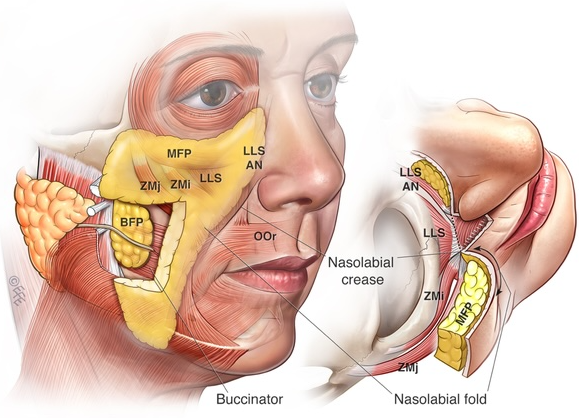
The cheek tissue above the fold descends. Facial retaining ligaments, which anchor soft tissue to deeper structures, gradually loosen. The cheek fat pads shift downward and forward, piling up against the relatively fixed nasolabial crease. That added weight above the fold is what makes the crease look deeper. The deep plane facelift and the midface guide covers this descent in more detail.
Volume loss compounds the effect. Soft-tissue thinning, fat deflation in the midface and subtle changes in the underlying bone reduce the upper-cheek support that previously held tissue away from the fold. Less support above means more accumulation along the fold line.
The crease itself has a structural component. The nasolabial crease is anatomically a fixed feature anchored by deep tissue attachments. That is why even significant tissue repositioning rarely makes the fold disappear entirely, and why filler placed directly into the fold often produces a heavier or more projected appearance rather than a smoother one. The fold has a foundation that injection alone cannot relocate.


 How a Deep Plane Facelift Can Soften the Fold

The mechanism matters, because it explains why the technique produces a different outcome than skin tightening alone.
A deep plane facelift dissects beneath the SMAS, the deeper fibromuscular layer of the face, enters the anatomical plane below it, and releases the retaining ligaments tethering descended cheek tissue. Once those ligaments are released, the deeper composite tissue can be mobilised and repositioned vertically, restoring cheek volume closer to where it sat earlier in life. The skin redrapes over the repositioned structure rather than being pulled tight on its own.
For nasolabial folds, the relevant effect is the cheek mass moving back up and away from the fold. With less tissue weight piled against the crease, the fold often looks softer at rest, even though the crease itself has not been directly treated.
A 2023 study in Plastic and Reconstructive Surgery reported that a modified deep-plane technique combining deep fat compartment mobilisation with adjacent muscle work produced better wrinkle severity scores than the authors’ earlier deep-plane approach, which suggests fold improvement depends on the exact technical detail rather than the label “deep plane” alone.
The result is structural rather than superficial, which is why the change tends to look more natural than aggressive skin tightening, and why it can hold up better over time when the anatomy suits the approach.
Why It Does Not Erase the Fold
This is the part most worth understanding before committing to surgery.
The fold has multiple contributors, and repositioning descended tissue addresses one of them. The structural crease anatomy, the volume loss, the skin quality and the underlying bone support are not addressed by a facelift alone. Patients whose folds are mainly caused by midface descent tend to see meaningful softening. Patients whose folds are mainly caused by volume loss, thin skin or a strong fixed crease often see less dramatic change, even with technically excellent surgery.
A 2025 critical review of 78 deep-plane procedures reported some recurrence of nasolabial fold appearance between 6 and 12 months in the cases studied, and concluded that deep-plane facelift is not suitable for every face type. That is not an argument against the procedure. It is an argument for honest assessment beforehand: which component of the fold is dominant, and which procedure or combination is most likely to address it.
The realistic framing is softening rather than erasing. Patients who arrive expecting their nasolabial folds to disappear after a facelift are often disappointed, even where the surgery itself produces a good result. For a fuller picture of the trade-offs, the risks and complications after facelift surgery guide covers what to factor into the decision.
Filler or Surgery?
The answer depends on the cause.
Filler can help where volume loss is the dominant factor and the fold is otherwise mild. By restoring volume in the upper cheek, it reduces the contrast between the fullness above the fold and the fold itself. It works less well where there is significant cheek descent, because adding volume to descended tissue often makes the heaviness above the fold more visible rather than less.
A deep plane facelift addresses the descent. By repositioning deeper tissue back to where it sat previously, the procedure changes the structural relationship between cheek and fold rather than camouflaging the fold from the outside. For patients with cheek descent, jowls and broader lower-face laxity, this is generally a more durable answer than repeated filler rounds.
The two also combine. Facial fat transfer at the time of facelift, restoring lost volume in the temples, cheekbones or under the eyes, can address the volume component alongside structural repositioning. The right plan follows the assessment rather than the patient’s starting assumption.
Deep Plane vs SMAS for Folds
The SMAS facelift is the more traditional approach. It works on the SMAS layer itself, tightening or repositioning it without dissecting beneath it, which means the deeper retaining ligaments stay intact. This is a reliable, well-understood operation producing good results for many patients. For nasolabial folds specifically, though, it has a structural limitation: with the ligaments still anchoring the cheek tissue, the amount of midface elevation achievable is more limited than a deep plane technique can produce.
The deep plane approach goes below the SMAS, releases the ligaments and mobilises the deeper composite tissue, so the cheek mass moves more freely. For folds primarily driven by cheek descent and ligament laxity, this generally produces more meaningful softening.
Both approaches have a role. Patient anatomy, skin quality, degree of midface descent, neck involvement, previous surgery and surgeon experience all factor into which is appropriate. A deep plane facelift is not categorically better than a SMAS facelift, and patients who arrive convinced they need one specific technique sometimes need a different conversation. The deep plane vs SMAS comparison covers the technical detail.
Who Is Most Likely to See Improvement?
Patients with visible midface descent, cheek heaviness and jowls tend to benefit, because the underlying problem matches what the procedure addresses. The fold softens because the tissue weight above it is repositioned, not because the crease has been treated directly.
Patients whose folds are mainly volume-loss driven, who have thin skin, a strong fixed crease anatomy or significant bony changes in the maxilla, often see less dramatic fold change. For these patients, fat transfer, filler, skin treatments or a different surgical plan may be more relevant. Surgery can still be appropriate for other reasons, including jowl correction, neck contour or overall facial proportion, but the fold-specific change may be modest.
Nasolabial folds sit at the intersection of anatomy, tissue descent, volume and skin quality. The fold is a symptom. The cause varies, and the right plan depends on which cause is dominant.
Is It Right for You?
For selected patients with cheek descent, jowls and broader midface laxity contributing to deeper folds, a deep plane facelift may produce meaningful softening. For patients whose folds are mainly volume-driven or anatomically structural, surgery may help less and other approaches may suit better. The trade-off is that this is real surgery, with scars, healing time and risks to understand before deciding.
Productive questions at consultation: which component of the fold is dominant in my case, whether descent, volume loss, skin quality or the structural crease? What degree of change would be realistic? Would adjuncts such as fat transfer, eyelid surgery or skin resurfacing be considered for overall balance? What are the specific risks and recovery expectations for my situation?
Current Medical Board and AHPRA requirements for cosmetic surgery in Australia include a referral, preferably from your usual GP or another independent practitioner; a minimum of two pre-operative consultations, with at least one in person with the operating surgeon; a cooling-off period of at least seven days after informed consent before surgery is booked or a deposit paid; and psychological screening for suitability.
Frequently Asked Questions
Does a deep plane facelift get rid of nasolabial folds? Not entirely. The procedure may soften them in suitable patients, but it does not remove them, because fold depth is affected by midface descent, volume loss, bone support, skin quality and a fixed crease anatomy. Surgery addresses the descent component by repositioning deeper cheek tissue up and away from the fold. The fold usually still exists after surgery, in a softer form. Patients with cheek heaviness and jowls tend to see the most change; patients whose folds are mainly volume-driven often see less.
Why do nasolabial folds improve after a deep plane facelift? Because the procedure releases the retaining ligaments anchoring descended cheek tissue and repositions the deeper composite tissue vertically rather than tightening skin. With the cheek mass moved back up, there is less tissue weight piled against the fold, and the crease appears softer at rest. The skin then redrapes over the repositioned structure. This is structural improvement rather than skin-tension improvement, which is why the result tends to look more natural and hold better when the anatomy suits the approach.
Is filler better than a facelift for nasolabial folds? It depends what is causing the fold. Filler can help where volume loss is dominant and the fold is otherwise mild, by restoring upper-cheek volume and reducing the contrast above and below the crease. It works less well where significant cheek descent is present, because adding volume to descended tissue can make the heaviness above the fold more visible. A deep plane facelift is more relevant for folds associated with cheek descent, jowls and broader laxity, and some patients benefit from both, with fat transfer addressing volume alongside surgical repositioning.
Can a SMAS facelift improve nasolabial folds? It can produce modest softening in selected patients. The structural limitation is that a standard SMAS technique works on the SMAS layer without dissecting beneath it, so the deeper retaining ligaments remain intact and the midface elevation achievable is more limited. A deep plane technique generally produces more meaningful softening for descent-driven folds because it releases those ligaments. Both approaches have a role, and the choice depends on individual anatomy, ageing pattern and goals.
Who is a good candidate if nasolabial folds are the main concern? Usually someone whose folds are part of broader midface descent, cheek heaviness, jowling or overall facial laxity, rather than an isolated crease caused mainly by volume loss or skin quality. The procedure works on the descent component, so patients with that pattern tend to see meaningful change. Patients whose folds are predominantly volume-driven, who have thin skin, or who have a strongly anchored fixed crease often need different or additional approaches. Suitability is assessed individually, looking at the dominant cause rather than the fold alone.
If nasolabial folds are your main concern, the useful assessment establishes which component is driving them, since that determines whether surgery, volume restoration or something else is the right answer. Dr Scott Turner consults in Sydney and Brisbane. For clinic information and the consultation pathway, visit the Sydney clinic or Brisbane clinic, or contact the practice to arrange a consultation.

