


Deep Plane Facelift at a Glance
| Detail | Information |
| Areas addressed | Midface, jowls, jawline and neck where indicated |
| Anaesthesia and stay | General anaesthesia in an accredited private hospital, usually one night |
| Surgical time | 3.5 to 5 hours; longer when combined with other procedures |
| Return to desk work | Usually 2 to 3 weeks; recovery varies between patients |
| Consultations | Bondi Junction and Manly |
| Surgery performed at | Bondi Junction Private Hospital and Delmar Private Hospital, Dee Why |
| GP referral | Required before booking a consultation |
| Indicative cost | Around $35,000 all-inclusive with a neck lift component; varies with surgical plan. No Medicare or private health rebate |
What Is a Deep Plane Facelift?
A deep plane facelift is a facelift technique that works beneath the SMAS layer. The surgical plan may involve releasing selected retaining ligaments and repositioning deeper facial tissues. This approach is different from skin-only tightening, and it is assessed according to each patient’s anatomy, tissue position, skin quality and medical history.
The reason the layer matters is that facial change is structural. The retaining ligaments lengthen over time, and the SMAS and the fat pads it carries descend. A technique that works on the skin or the SMAS surface alone addresses the appearance rather than the position of the deeper tissues. A deep plane technique releases selected structures contributing to descent, then repositions the deeper tissues in the opposite direction.
The technique was developed and refined over several decades and is used for patients with changes in the midface, jowls and jawline where deeper tissue descent, rather than skin laxity alone, is the main finding.
How Deep Plane Facelift Surgery Works
Facelift techniques differ mainly in which layer of the face they work in. Three structures determine what a deep plane approach is able to move: the SMAS, the retaining ligaments that tether it, and the surgical plane that lies beneath both.
The SMAS Layer
The SMAS (superficial musculoaponeurotic system) is a continuous fibrous sheet lying between the skin and the deeper structures of the face. It runs from the platysma muscle in the neck, up through the cheek, and connects with the muscles of the forehead, forming one continuous layer rather than several separate ones.
The SMAS carries the facial fat compartments and is continuous with the muscles of facial expression, so its position largely determines the position of the overlying soft tissue of the cheek, jawline and neck. With time, the SMAS and the tissues it supports descend.
Retaining Ligaments
The retaining ligaments are short fibrous bands that tether the skin and SMAS to the underlying bone and deep fascia. They hold the soft tissues in position over the moving muscles of facial expression. Over time these ligaments lengthen, and the tissues they support settle downwards and towards the midline, contributing to midface flattening, jowl formation and loss of jawline definition.
The ligaments relevant to facelift surgery sit in a predictable sequence from the temple to the jaw:
- Temporal ligamentous adhesion. At the lateral brow and temple, where the superficial and deep temporal fascia meet.
- Orbital retaining ligament. Along the lower orbital rim, contributing to the lid-cheek junction as the midface descends.
- Zygomatic ligaments. Over the cheekbone, anchoring the malar fat pad. Lengthening here contributes to midface descent and deepening of the nasolabial fold.
- Masseteric ligaments. A vertical series along the anterior border of the masseter muscle, supporting the cheek and upper jawline. Laxity here contributes to jowling.
- Mandibular ligament. Near the front of the jaw, tethering the tissue that forms the boundary of the jowl and the pre-jowl hollow.
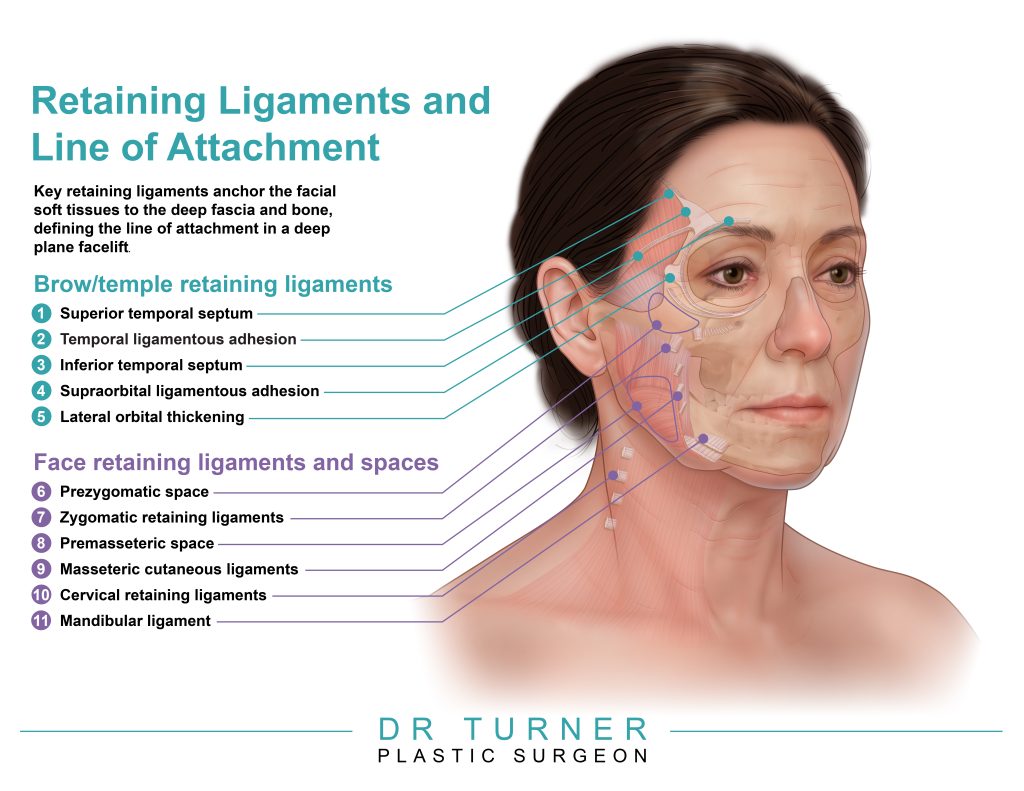
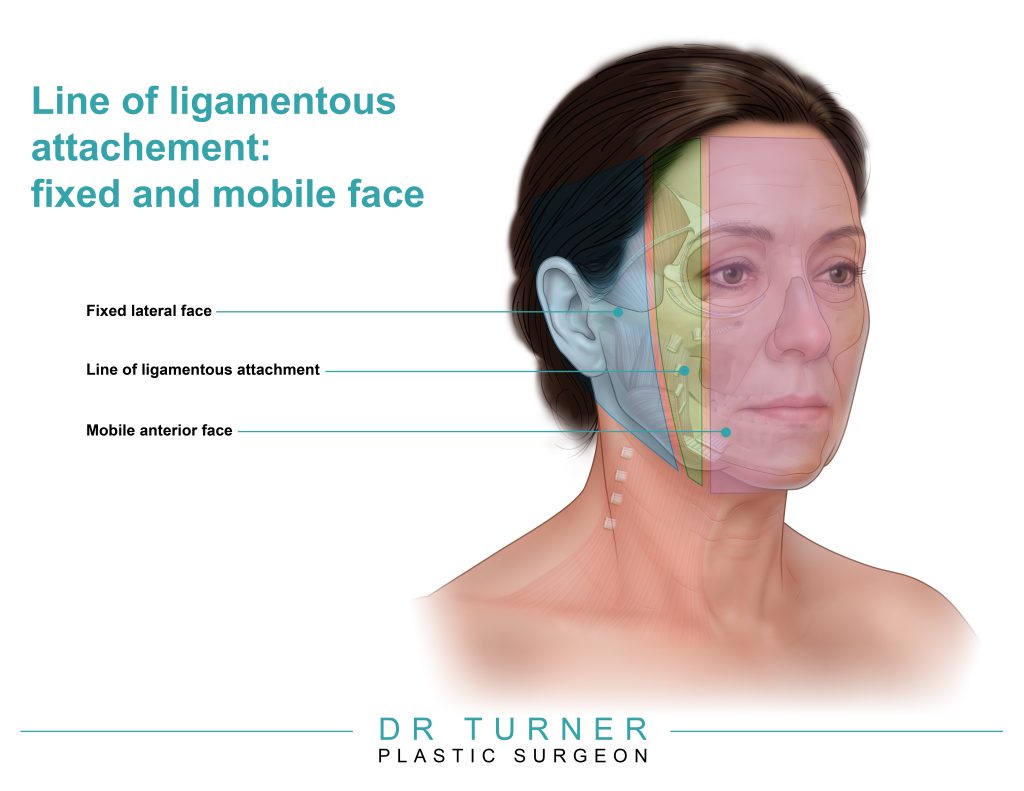
Together these attachments form a near-vertical line running from the lateral orbit to the jaw, described as the line of ligamentous attachment. It separates the lateral face, which is relatively fixed, from the anterior face, which is comparatively mobile. This is the anatomical reason a technique that pulls on the lateral face alone tends to have limited effect on the midface: tension applied lateral to this line is largely absorbed by the ligaments rather than transmitted across them.
The Deep Plane
The deep plane is a surgical plane lying beneath the SMAS and above the deeper structures of the face, including the parotidomasseteric fascia, the buccal fat pad and the branches of the facial nerve, which run deeper still.
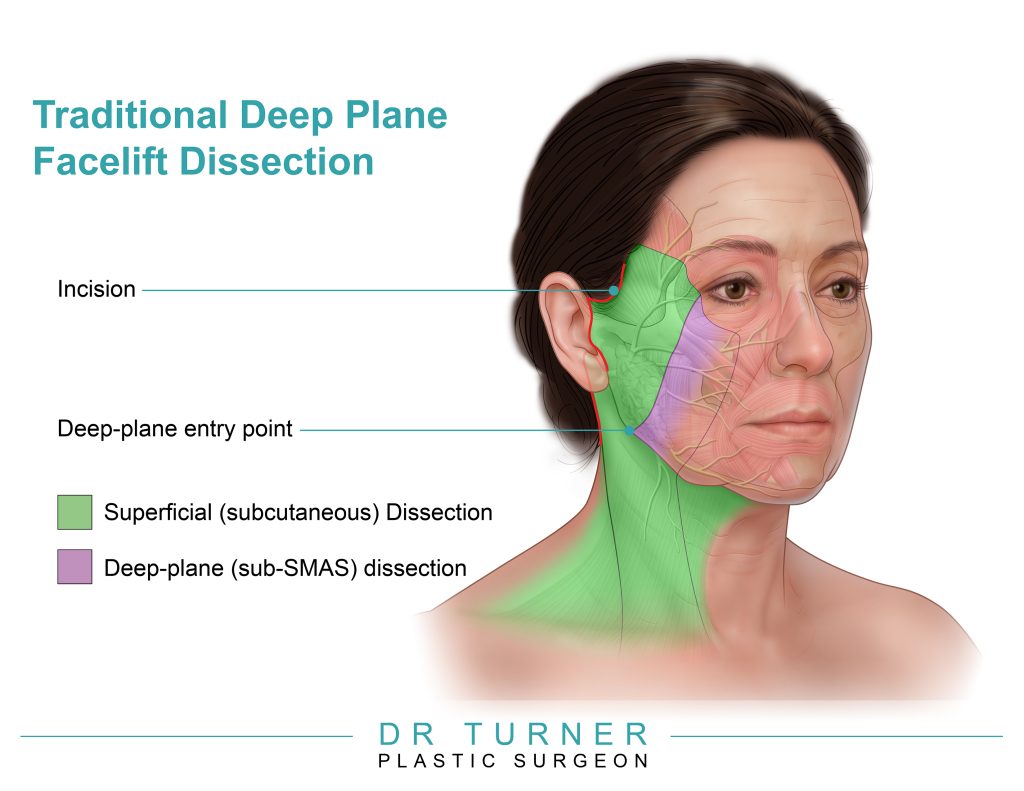
Dissecting in this plane separates the SMAS from the tissue beneath it while the skin remains attached to the SMAS above. The skin and SMAS are lifted together as a single composite unit rather than as two layers moved independently, which means the movement comes from repositioning the deeper tissue rather than from tension applied to the skin.
Selected retaining ligaments are released along the way, since the ligaments would otherwise resist the movement of that composite layer. Release is selective rather than routine. These ligaments lie close to branches of the facial nerve, and the ligaments addressed, the extent of the dissection and the direction of repositioning are planned according to each patient’s anatomy, tissue position and surgical history, and are discussed at consultation. How far that dissection extends is what distinguishes the preservation and extended approaches described below.
Preservation and Extended Deep Plane Techniques
Preservation and extended describe two halves of the same modern approach rather than two competing operations. One concerns how much skin is lifted away from the layer beneath it. The other concerns how far the release beneath the SMAS extends. They are used together because each depends on the other: if the skin is not separated from the SMAS, the movement has to come from the deeper release, and a more complete ligament release is what allows that layer to move.
Preservation: Limiting the Skin Dissection
Deep plane surgery has conventionally begun with a broad subcutaneous flap, lifting the skin off the fat and SMAS across the lateral cheek and neck before the deep plane is entered. A preservation approach keeps that skin dissection to a minimum instead. The skin is lifted off the SMAS only for a short distance in front of and behind the ear, sufficient to gain access. Beyond that the skin, subcutaneous fat and SMAS-platysma layer remain attached to one another.
The rationale is anatomical. Much of the blood supply to the facial skin runs within the subcutaneous layer, and keeping the layers attached disturbs less of it. Retaining that circulation may reduce bruising and swelling in the early recovery period and is relevant to wound healing, particularly in patients with additional healing risk factors such as smoking. Recovery still varies between patients, and direct comparisons between facelift techniques in the published literature remain limited.
Extended: More Complete Ligament Release
Extended describes how far the sub-SMAS dissection continues once the deep plane has been entered. A more extended release continues medially across the zygomatic and masseteric ligaments toward the midface, and inferiorly past the mandibular ligament, so that the SMAS and the platysma are addressed as one continuous sheet into the upper neck.
The purpose of releasing the ligaments more completely is directional as well as structural. Facial descent occurs downward and toward the midline, so the tissue needs to be repositioned upward, along a vertical vector, rather than pulled backward toward the ear. The retaining ligaments resist vertical movement in particular, and a fuller release is what allows the deeper layer to be repositioned in that direction. It also means dissecting over a broader field and closer to branches of the facial nerve, which is why the extent of release is planned according to anatomy rather than applied routinely.
Why the Two Work Together
Limiting the skin dissection and extending the ligament release are complementary parts of the same plan. Because the skin, fat and SMAS-platysma remain attached, they behave as a single composite flap, and a composite flap can only be moved as far as the ligaments beneath it allow. Releasing those ligaments more completely is therefore what makes the preservation approach workable, and keeping the layers attached is what allows the repositioning to come from the deeper layer instead of from tension on the skin.
Comparing the two illustrations shows the difference directly. In the traditional dissection above, the green subcutaneous area is broad and the purple sub-SMAS area comparatively small. In a modern approach, the proportions are reversed: the green band is narrow, and the purple area extends further across the midface and jawline.
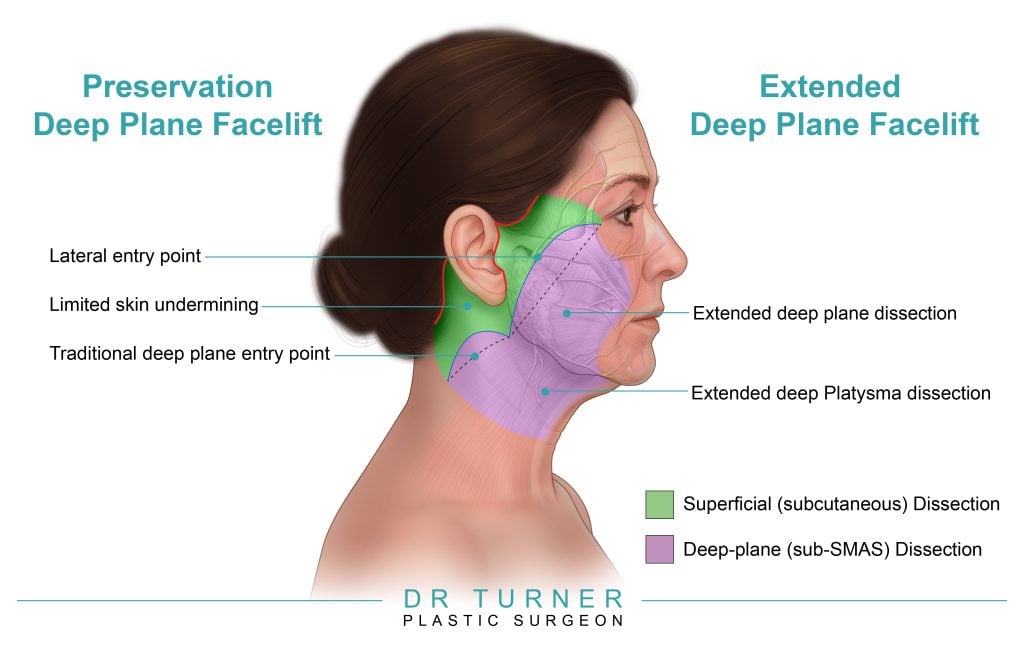
Neither element is applied as a default. The extent of skin dissection, which ligaments are released, how far the release continues and the direction of repositioning are planned according to anatomy, tissue position, skin quality, prior surgery and what is being addressed, and are discussed at consultation. Further detail is set out in the preservation deep plane facelift and extended deep plane facelift guides.
Deep Plane Facelift Before and After
The photographs below are of Dr Turner’s patients, published with their consent. Each set shows the same patient before surgery and at a stated interval afterwards. Results vary between patients because anatomy, skin quality, tissue position, healing and surgical planning differ. The images indicate the type of change surgery may produce for a particular anatomy, not a guaranteed or typical outcome.
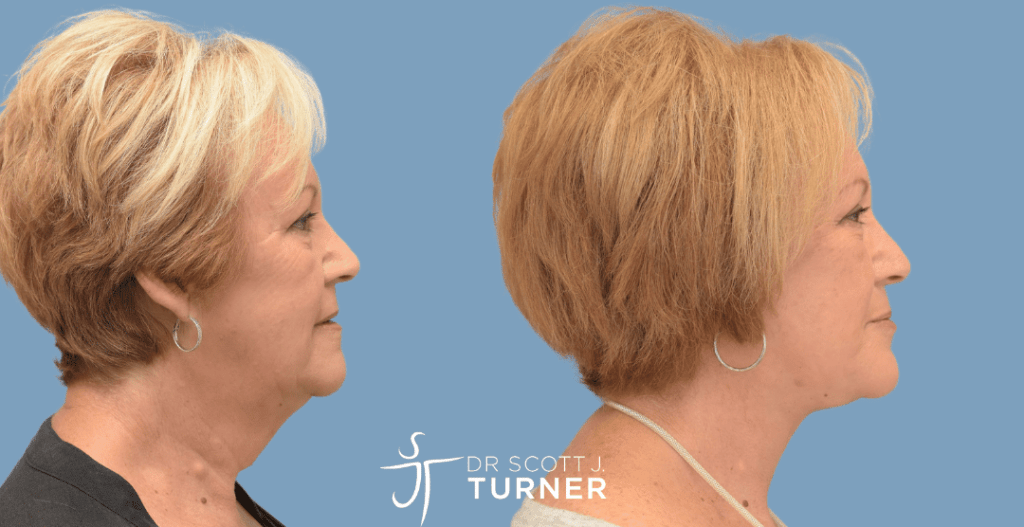
Further examples, along with guidance on what to look for when reviewing surgical photographs, are in the facelift before and after gallery. Relevant case examples may also be discussed during consultation where appropriate.
Combining a Deep Plane Facelift with Other Procedures
A deep plane facelift repositions the deeper tissues of the midface, jowls and jawline. It does not change eyelid position, brow height, skin texture or the area around the mouth, so where those also contribute to a patient’s concerns, other procedures may be considered.
The neck is the most commonly combined component, and a deep plane facelift can be performed with or without a formal neck lift or deep neck lift. Others that may be considered include:
- Upper blepharoplasty for excess upper-eyelid skin.
- Lower blepharoplasty for under-eye fat and lower-eyelid skin.
- Brow lift for brow descent contributing to upper-face heaviness.
- Facial fat transfer for volume loss in the midface and temples.
- Lip lift for lengthening of the upper lip.
Combining procedures means one anaesthetic and one recovery rather than two, but also a longer operation and more swelling. Whether procedures are combined or staged is a clinical decision based on anatomy, general health and what is being addressed, rather than a package.
Who May Be Suitable for a Deep Plane Facelift?
A deep plane approach is generally considered when the changes are structural rather than skin-deep: the cheek sitting lower than it once did, jowls forming along the jawline, and a softening of the line between the jaw and the neck. Where the main concern is skin texture or surface change, a different approach is usually more appropriate.
Assessment at consultation covers:
- Which layers are contributing to the changes, and whether the neck is involved.
- General health and suitability for a longer general anaesthetic.
- Skin quality and how the tissue is likely to settle.
- Smoking status. Smoking reduces blood supply to the facial skin and increases the risk of delayed healing and wound problems. Cessation is expected before surgery.
- Previous facial surgery or non-surgical treatments.
Assessment of psychological factors forms part of every cosmetic surgery consultation. In line with Medical Board requirements, Dr Turner personally screens each patient for underlying psychological conditions, including body dysmorphic disorder. Where screening indicates significant underlying issues, the patient is referred for evaluation by a psychologist, psychiatrist or general practitioner who works independently of the practice, and that evaluation informs whether surgery is appropriate. Expectations are discussed in the same consultation, including what surgery can and cannot change, what recovery involves, and the possibility that further or revision surgery may be needed.
Surgery is not appropriate in every case. Where the findings do not suit a deep plane approach, Dr Turner will say so and discuss the alternatives, which may include a different facelift technique, a non-surgical option, or no treatment.
A face-to-face consultation following GP referral is required before suitability can be confirmed.
Deep Plane Facelift Recovery
A deep plane facelift involves a meaningful period of downtime, and planning for that is part of deciding whether to proceed. Recovery varies between patients, and swelling, bruising, tightness and temporary altered sensation are expected rather than unusual.
A hospital stay of around one night is usual. Swelling and bruising build over the first few days and begin to settle through the second week, with many patients returning to desk-based work between weeks two and three. Visible bruising usually resolves by weeks four to six. Much of the swelling has settled by around three months, while tissue settling and scar maturation continue over six to twelve months. Recovery takes longer when the facelift is combined with brow lift, blepharoplasty or neck lift components, because the surgical area is broader.
Recovery is not finished when the visible bruising has gone. Follow-up appointments continue through this period to monitor healing, and post-operative care and scar management influence how the result settles. Patients should plan for that continued involvement rather than expecting a single point at which recovery is complete.
A week-by-week account of what to expect is set out in the recovery after facelift surgery guide.
Deep Plane Facelift Cost in Sydney
Facelift cost 2026
All-inclusive pricing, one fee
Every figure covers surgeon, hospital, anaesthesia, and all follow-up appointments. No separate bills.
A formal itemised quote is provided after consultation, based on your surgical plan. Facelift surgery is cosmetic and is not covered by Medicare.
Risks and Complications
All surgery carries risk. Risks relevant to deep plane facelift surgery, discussed in detail at consultation, may include:
- Bleeding and haematoma. A collection of blood beneath the skin, most common in the first 24 hours, which may require return to theatre.
- Facial nerve injury. Temporary or, less commonly, permanent weakness of the muscles of facial expression. The retaining ligaments released during deep plane surgery lie close to branches of the facial nerve.
- Infection. Uncommon in clean facial surgery but possible.
- Scarring. Scars are permanent. Most fade over months, but raised, thickened or keloid scarring is possible and is more likely in patients with a history of it.
- Delayed wound healing. Increased in patients who smoke or have poorly controlled medical conditions.
- Altered sensation or numbness. Around the ears, cheeks and scalp, usually improving over months.
- Asymmetry. Minor asymmetry may persist, as no two sides of any face are identical.
- Hairline or skin changes. Including temporary hair loss near incisions.
- Anaesthetic risks. Associated with general anaesthesia.
- Need for further surgery. To address healing or to revise an outcome.
- Dissatisfaction with the outcome. Where the result does not meet expectations, or where the change is less than hoped for. Revision surgery is not always possible or appropriate.
Risk is reduced by smoking cessation, optimisation of general health, careful surgical technique, an accredited private hospital setting and structured follow-up.
Further detail is set out in the risks and complications after facelift surgery guide, and general information for all procedures is on the risks and complications page.
Deep Plane Facelift Consultations in Sydney
Consultations with Dr Scott J Turner are available at two Sydney clinics.
The Bondi Junction clinic is at 39 Grosvenor Street, Woollahra NSW 2025, a short walk from Bondi Junction station and Westfield. The Manly clinic is at Suite 504, Level 5, 39 East Esplanade, Manly NSW 2095, close to Manly Wharf. Deep plane facelift surgery is performed at Bondi Junction Private Hospital and Delmar Private Hospital, Dee Why.
A GP referral is required before booking a consultation, in line with Medical Board and AHPRA requirements for cosmetic surgery in Australia. Dr Turner conducts a minimum of two consultations before proceeding with surgery, both personally.
To request a consultation, contact the practice on 1300 437758 or [email protected], or visit the contact us page.
Deep Plane Facelift FAQs
What is a deep plane facelift?
A deep plane facelift is a facelift technique that works beneath the SMAS layer, releasing selected retaining ligaments so deeper facial tissues can be repositioned. It addresses changes in the midface, jowls and jawline at a structural level rather than tightening skin alone. Dr Scott J Turner performs deep plane facelift surgery at Bondi Junction Private Hospital and Delmar Private Hospital, Dee Why.
How does a deep plane facelift differ from a SMAS facelift?
A SMAS facelift works with the SMAS layer by folding or partially releasing it. A deep plane facelift dissects beneath the SMAS and releases selected retaining ligaments, repositioning the deeper tissues of the midface and jawline. The appropriate approach depends on anatomy, tissue position and the areas being addressed, and is assessed at consultation.
What is the difference between preservation and extended deep plane facelift?
Preservation and extended deep plane describe different degrees of dissection and ligament release. A preservation approach is more limited, while an extended approach releases the retaining ligaments more fully and accesses the jawline and upper neck more comprehensively. Recovery and swelling vary between patients. The choice depends on anatomy, tissue position and goals discussed at consultation.
Who may be suitable for a deep plane facelift?
Suitability depends on anatomy, tissue position, skin quality, medical history, prior surgery and the concerns to be addressed, rather than on age alone. Most patients present with midface, jowl or jawline changes. General health, anaesthetic suitability, smoking status and realistic expectations are also assessed. Candidacy is determined at consultation following a GP referral.
Is a neck lift included in a deep plane facelift?
A deep plane facelift can be performed with or without a formal neck lift. For isolated lower-face and midface changes, the facelift alone may be sufficient. Where there is platysmal banding, submental fullness or cervicomental angle change, a deep neck lift may be integrated. Surgical time, recovery and cost vary accordingly. The decision is made at consultation.
What is the recovery timeline for a deep plane facelift?
Recovery varies between patients. Swelling, bruising, tightness and temporary altered sensation may occur. Drains are usually removed within the first two days and sutures over the following one to two weeks. Many patients plan two to three weeks away from work. Healing continues over several months, with follow-up appointments used to monitor progress.
What does a deep plane facelift cost in Sydney?
Deep plane facelift cost in Sydney varies because each surgical plan differs. Factors include surgical complexity, operating time, anaesthetist and hospital fees, post-operative care and whether another procedure is included. An indicative all-inclusive figure is around $35,000 with a neck lift component. Medicare and private health rebates do not apply. A personalised quote is provided after consultation.
Can I see deep plane facelift before and after photos?
A selection of Dr Turner’s facelift results can be viewed in the facelift before and after gallery, and relevant case examples may be discussed during consultation where appropriate. Results vary between patients because anatomy, skin quality, tissue position, healing and surgical planning differ. Before and after photographs indicate the type of change surgery may produce for a particular anatomy, not a guaranteed outcome.

